ADC Concentration Guidance: Construction Monitoring
A community bank that makes residential construction loans carries them in its acquisition, development and construction (ADC) concentration: the construction, land development and other land number in the supervisory screen. The guidance that sets that screen also names the controls a bank with construction loans should have, and an inspection process is one of them.
This guide covers what the interagency guidance says, what it does not say, and what a construction monitoring file looks like at a bank near or above the screen. It is a reading of published supervisory guidance as of November 2026, not legal advice; confirm how it applies to your bank with counsel and your examiner.
What the guidance says
In December 2006 the OCC, the Federal Reserve and the FDIC issued supervisory guidance, Concentrations in Commercial Real Estate Lending, Sound Risk Management Practices (71 FR 74580). It counts land development and construction loans, including 1- to 4-family residential construction loans, among commercial real estate loans. A bank may get closer supervisory review when its construction, land development and other land loans reach 100 percent or more of total capital, or when its total CRE loans reach 300 percent or more of total capital after the CRE portfolio grew 50 percent or more over the prior 36 months. The agencies said the criteria are not a limit on how much CRE lending a bank may do.
Two later documents changed the measurement, not the idea. Since March 31, 2020, under an interagency statement the FDIC issued as FIL-31-2020, examiners calculate these ratios on tier 1 capital plus the loan loss allowance (for a bank on CECL, the part of the allowance for credit losses attributable to loans and leases). The FDIC's December 2023 advisory, Managing Commercial Real Estate Concentrations in a Challenging Economic Environment (FIL-64-2023), restates both criteria on that base and says they are not regulatory limits. In between, the agencies' December 18, 2015 Statement on Prudent Risk Management for Commercial Real Estate Lending reminded banks to keep risk management that identifies, measures, monitors and manages the risks of their CRE lending.
A screen, not a limit.
Crossing 100 or 300 percent does not cap a bank's lending. It tells examiners where to look, and it puts weight on the risk management the bank can show.
Where inspections come in
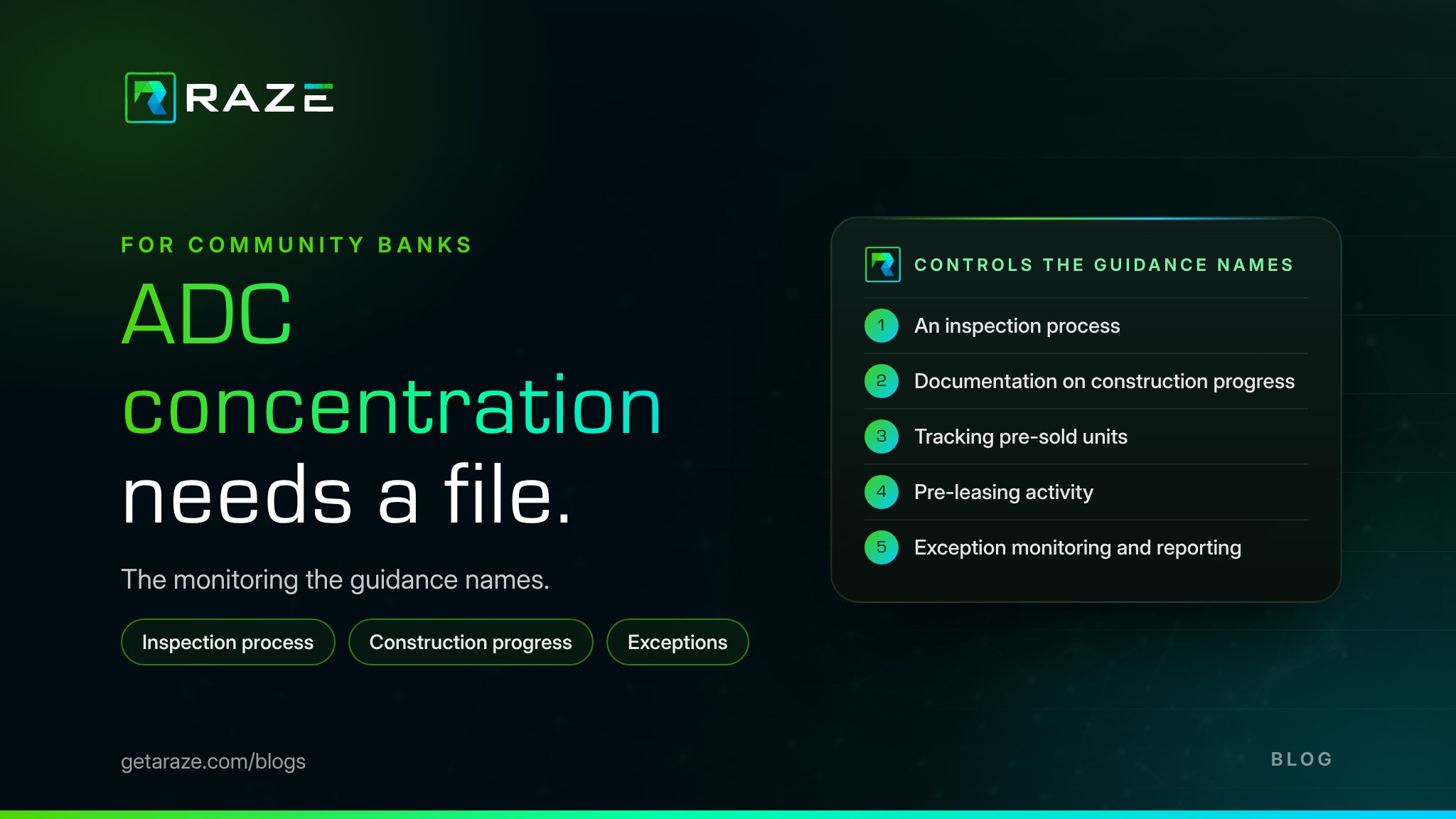
The 2006 guidance lists seven elements of risk management for a concentration: board and management oversight, portfolio management, management information systems, market analysis, credit underwriting standards, portfolio stress testing and sensitivity analysis, and a credit risk review function. It also turns to construction directly. Disbursement procedures should keep the borrower's minimum equity in place through construction, and in the guidance's words, "Prudent controls should include an inspection process, documentation on construction progress, tracking pre-sold units, pre-leasing activity, and exception monitoring and reporting."
The FDIC's construction and land development examination procedures show how an examiner tests that process: whether inspections happen on an irregular schedule and before draw requests, whether reports are detailed enough to support disbursements, and whether disbursements are made only after management reviews written inspection reports, lien searches and title updates. None of these documents sets an inspection frequency, requires an outside inspector or names a tool. Those choices belong in the bank's own draw inspection policy.
What the monitoring file should show
An inspection process, in writing
Who orders, who inspects, when, and what the report must hold. The FDIC's procedures also ask whether inspectors are qualified and independent of the lending function.
Construction progress, documented
Percent complete by budget line with dated photos, in one format across inspectors. See the report standard.
Equity held through the build
Funds disbursed kept behind work in place, so the borrower's equity is still in the project at every draw.
Pre-sold units, tracked
On builder lines and spec homes, which houses are sold and which are not. See spec home inspection policy.
Pre-leasing, where the exit is rent
On rental builds, what is leased against what the exit assumes. See rental build draws.
Exceptions, reported up
Draws funded without a fresh inspection, draws an inspection did not support and sites that stopped, reported to management. See construction draw red flags.
From the draw to the portfolio
Concentration is a portfolio measure, and the guidance's management information systems element asks a bank to see the portfolio, not only each loan. Inspection reports in one format can be read across the book: which projects have not moved since the last visit, which builders carry several open loans, and where funds disbursed are running ahead of work in place. A bank that can answer those questions from its own records shows the monitoring the guidance describes.
Credit unions work under the NCUA instead. For commercial construction and development loans, 12 CFR 723.6 releases funds only after on-site inspections documented in a written report; the credit union guide covers that lane.
Where RAZE fits
In RAZE, a bank orders draw inspections in the Ordering Engine with its required questions and photos attached, and sends each one to its own inspector through Direct Request or to a RAZE Marketplace inspector, at any U.S. address. Photos carry GPS coordinates and date and time stamps and link to the draw sheet line items they support, and each inspection keeps a history of its status changes and who made them. The bank's reviewer accepts or rejects each submitted inspection, unless the institution has turned on auto-approve, a workflow setting rather than an AI decision.
Every report comes back in the bank's format, and RAZE Analytics runs preset reports or answers a question in plain language across those inspections. RAZE integrates with the construction loan administration a bank already runs and replaces none of it. The record is built to support audit and exam review; the bank decides what to fund.
Frequently asked questions
Keep reading
Monitoring you can show an examiner
One inspection process and one report format across the construction book.
For Lenders
See a draw inspection on a project in your book, from order to delivered report.
Request a DemoConcentration is a number.Monitoring is the file behind it.
Show the monitoring behind the number.
Request a Demo