Construction Draw Red Flags Lenders Should Document
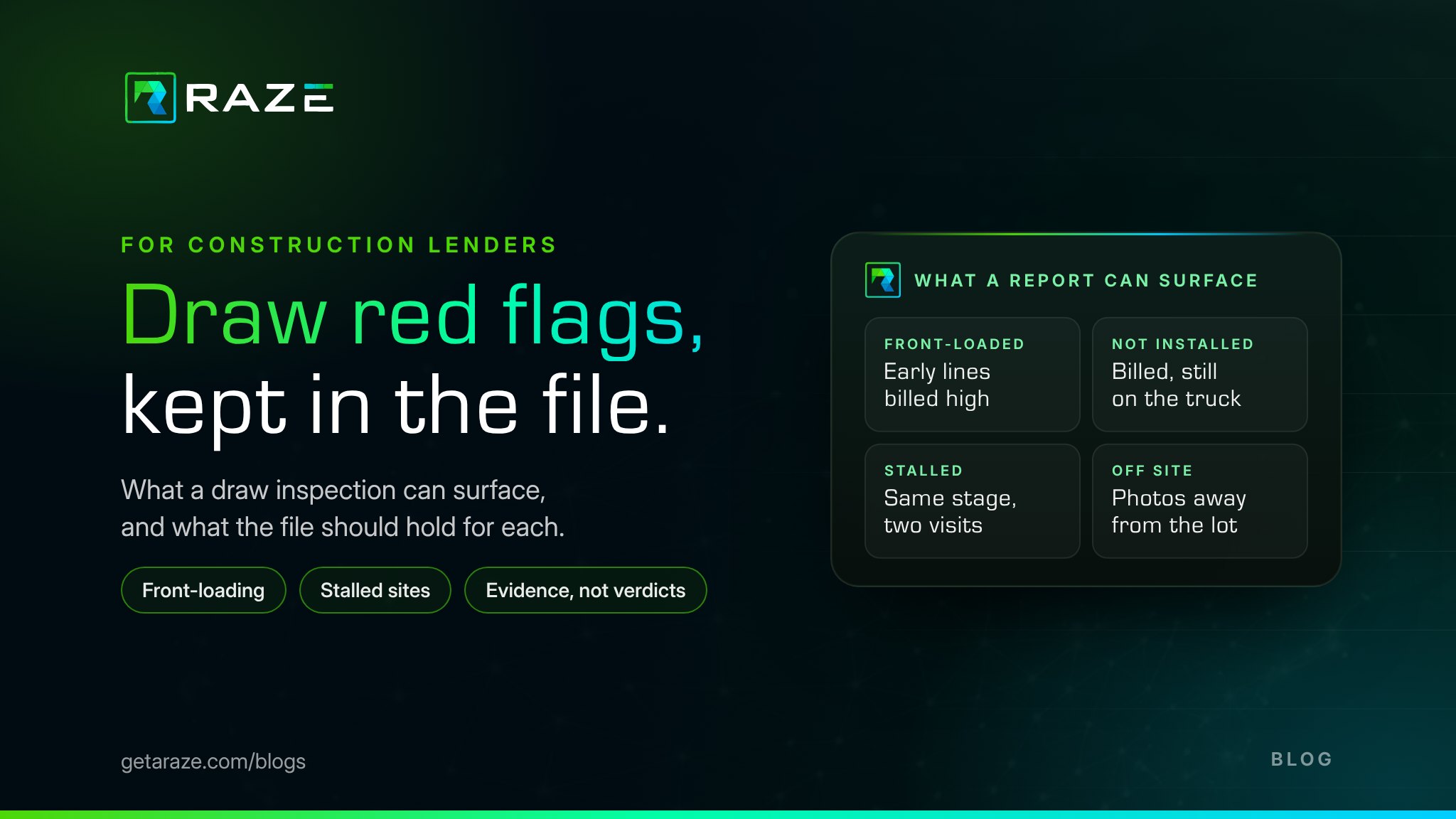
A red flag on a construction draw is a fact that needs an explanation. Most have an ordinary one: a late delivery, a change order still in review, a builder who bills a little early. What matters is that the file shows the lender saw it, asked about it and decided on the record.
This guide lists the red flags a draw inspection can surface and what the file should hold for each. It is not a method for proving intent; no inspection does that. The inspector documents what is on site, and the lender decides what to fund.
Why regulators care about the record
The FDIC's examination manual lists construction draws made without visual inspections among its warning signs (section 9.1). The OCC's Comptroller's Handbook warns about front loading, where a builder deliberately overstates the cost of the early stages of construction, and says that if the bank does not catch it early there will almost certainly be insufficient loan funds to complete construction if there is a default. The same handbook looks for disbursement controls that keep draws commensurate with verified improvements and the budget in balance with enough left to finish.
Eight red flags and what to keep
| Red flag | What the inspection shows | What the file should add |
|---|---|---|
| A front-loaded budget | What the inspection showsEarly lines billed near complete while the site is still at an early stage | What the file should addThe original budget, the draw schedule and any request to move money between lines |
| Materials billed but not installed | What the inspection showsA line billed as complete with the items missing, or stored rather than installed | What the file should addThe lender's stored-materials rule, the invoice and where the materials are kept |
| A stalled site | What the inspection showsThe same stage on two visits in a row, with no new work since the last report | What the file should addThe builder's explanation and a revised schedule |
| Work out of sequence | What the inspection showsFinish lines billed while rough-in work is still open | What the file should addThe reviewer's reason for funding or holding those lines |
| Work that differs from the plans | What the inspection showsA changed layout, scope or material compared with the approved plans | What the file should addAn approved change order, or a hold until one is approved |
| Paid work without lien releases | What the inspection showsNothing on site; lien status is a paper question | What the file should addLien waivers and a title update before the release, as policy requires |
| An inspection that keeps getting moved | What the inspection showsAccess refused, a locked site or repeated rescheduling | What the file should addEach attempt, the reason given and any approved exception |
| Photos that do not match the address | What the inspection showsPhoto locations away from the property, or dates that do not match the visit | What the file should addA reinspection and a note confirming the address |
A red flag is a question, not a verdict.
An inspection reports what is on site. When a pattern points beyond an honest mistake, follow your institution's escalation procedures and talk to counsel.
What the file should show
For each flag, the file should answer four questions: when it was seen, what the lender asked, what the builder answered and who decided what to fund. The FDIC's construction and land development examination procedures look for disbursements made only after management reviews written inspection reports, lien searches and title updates, so the decision belongs beside the report it relied on.
A flag rarely means the whole draw stops. A lender can fund the lines the report supports, hold the lines it does not and reinspect once the gap is closed. See what happens when an inspection shows less work and whether a builder can dispute the report. For paid work and releases, see construction loan lien waivers.
Where RAZE fits
A RAZE draw inspection reports percent complete for each draw sheet line, with photos linked to the lines they support and GPS coordinates and date and time stamps on every photo, so the report shows where and when each line was seen. Each inspection keeps its status history, and a rejected report goes back to the inspector with the reviewer's reason, so the decision sits in the same record as the evidence. Through the RAZE MCP, an MCP-compatible AI assistant can review the capture metadata behind each photo, including GPS location, date and time stamps and the device that took it, which makes "was this photo taken on site, and when?" a question the lender can answer from the file.
Through RAZE, a draw inspection is a flat $125 per single-family inspection when RAZE sends the inspector, or $25 per request with your own inspector, at any U.S. address. See the RAZE Rate Card. RAZE documents the evidence; the lender reviews it and decides what to fund.
Frequently asked questions
Keep reading
When an inspection shows less work
The lender's options when a draw is not supported.
Construction loan lien waivers
Where the inspection fits beside lien controls.
Spotting a stalled spec home
Inspection policy across a builder's line.
Draw inspection policy
Seven sections a bank or credit union writes down.
Evidence on every line
Located, dated photos tied to each draw sheet line, with the reviewer's decision in the same record.
For Lenders
See a draw inspection on a project in your book, from order to delivered report.
Request a DemoSee the flag. Ask the question.Keep the answer in the file.
Evidence on every line of every draw.
Request a Demo