Presold
A buyer is under contract. Each inspection shows whether the house will be finished in time for the closing that repays it.
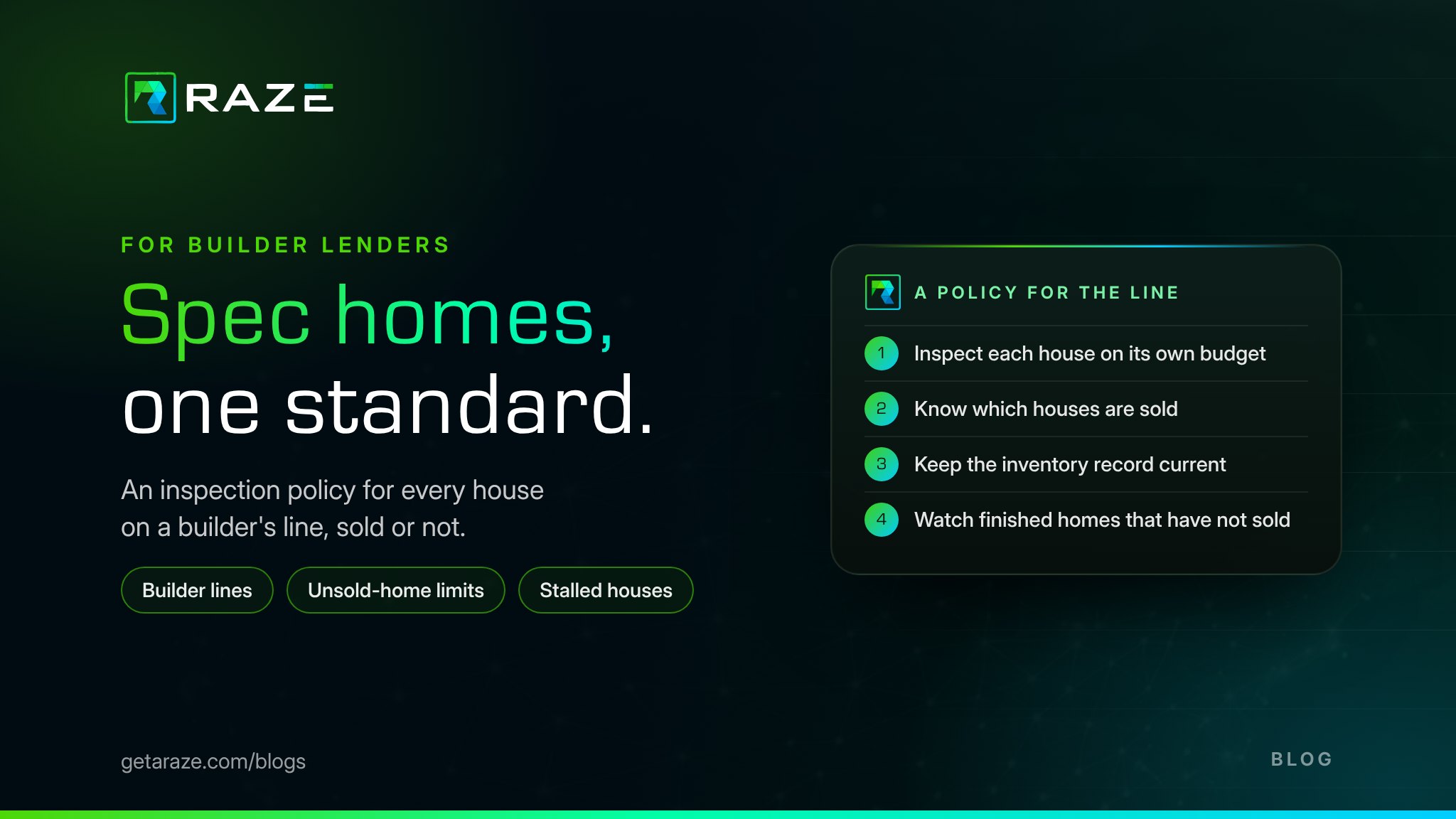
A builder line does not fund one house. It funds a builder's pipeline: homes already sold to a buyer, spec homes started before anyone signed, a model or two, sometimes finished lots. An inspection policy written for one borrower building one house does not fit that file.
This guide covers what supervisors expect from speculative construction lending, how to set inspection policy across a builder's line and how to spot a spec house that has stopped moving. Draws on a production subdivision, house by house, are covered in custom home vs. production builder draws. The loan agreement and the lender's policy decide how each house funds.
A presold home is repaid when the buyer closes. A spec home is repaid when the builder finds a buyer, so the loan rests on the market as much as on the construction. That is why supervisors treat spec lending as a policy question before it is a credit question.
The FDIC's examination manual says proposals to finance speculative housing should be judged against predetermined policy standards suited to the institution's size, its management's technical competence and the housing needs of its service area, and that a limit on the number of unsold units financed at any one time is typically written into the loan agreement so the builder is not overextended. The OCC's Comptroller's Handbook describes the same limit as a number or dollar amount of unsold units, speculative units and models included, across all of a builder's projects and across the projects the bank finances, set with the expected absorption rate in mind.
A buyer is under contract. Each inspection shows whether the house will be finished in time for the closing that repays it.
Started before a buyer signed. Each inspection shows progress and condition, and how long the house has been at each stage.
Built ahead of sales to show buyers. It counts toward the unsold-unit limit with the spec homes, and is sold when its use as a model ends.
Every house funds on its own schedule, so every report names the address or lot, the stage and the budget lines the advance pays for.
The FDIC's construction and land development examination procedures ask whether inspections are made on an irregular schedule and before draw requests, by qualified inspectors independent of the lending function.
Record each house as presold, spec or model when it is ordered, so the inspection history lines up with the unsold-unit limit.
The same FDIC procedures look for a limit on the speculation and model homes built ahead of sales and for inventory control records of unreleased units and developed lots. Inspection dates and stages feed that record.
The OCC notes that borrowing-base rules commonly limit how long a completed unsold unit may stay in the base. A periodic visit documents its condition while it waits.
The OCC's handbook says inventory, construction starts and sales should be monitored to avoid an excessive inventory buildup. Compare the line's starts and completions with its sales.
When work stalls on a home with no buyer, the balance stays outstanding with no progress behind it. The report should show when work stopped, not only how far it got.
The OCC's handbook lists lower than projected selling prices, slow sales and excessive inventory relative to sales as signs a borrower may have trouble repaying, and it describes principal curtailments that re-margin the loan when sales fall short. On site, the earlier signal is a house that stops changing.
What an inspection can document is evidence, not a forecast: the same stage reported on two visits in a row, materials on site that have not moved, an open or unsecured house, or a site where no work has been done since the last visit. Dated photos make the comparison with the previous report simple. When an inspection does not support the amount requested, the lender decides what funds; see what happens when an inspection shows less work.
A draw inspection reports what is on site. Spec limits, curtailments, extensions and every release of funds stay with the lender.
In RAZE, each house is its own project with its own address, and the lender orders, routes and tracks every inspection across the builder's line from the Ordering Engine. The lender sets the required questions and photos, so the items its spec policy adds travel with every order, and the inspector completes them in the RAZE Mobile App. Photos carry GPS coordinates and date and time stamps and link to the draw sheet line items they support, so each report places the house on its lot and in time. An inspection can also be ordered between draws, through the same workflow, when a house looks stalled, and for a finished home waiting for a buyer, the project's Workflow tab can schedule recurring inspections with a start, an end and a frequency, and email the people you choose when a status changes.
Through RAZE, every house on the line is priced the same: a flat $125 per single-family inspection when RAZE sends the inspector, or $25 per request with your own inspector, at any U.S. address. See the RAZE Rate Card. RAZE documents the work; the spec limits and the funding decisions stay with the lender.
Custom home vs. production builder draws
Line-item budgets, stage schedules and cadence.
Construction loan inspection frequency
What the FDIC researchers found about inspection timing.
When an inspection shows less work
The lender's options when a draw is not supported.
What is a draw schedule?
Milestone and line-item schedules, side by side.
The same report for each house, sold or spec, wherever the builder builds.
See a draw inspection on a project in your book, from order to delivered report.
Request a DemoOne inspection standard for every house on the line.
Request a Demo