Construction Loan Inspection Frequency: FDIC Research
A credit committee asks why the policy says to inspect every draw, and nobody in the room can point to anything but habit. Construction loan inspection frequency is one of the few lending controls with public research behind it, and most written policies never use it.
The research is an FDIC Center for Financial Research working paper, Bank Monitoring with On-Site Inspections, by Amanda Heitz, Christopher Martin and Alexander Ufier (CFR Working Paper 2022-09). Below is what it measured, what it found, what it does not say and how to turn it into a schedule you can defend. For the short answer, see how often draw inspections are required, with the sources behind it.
What the study measured
The authors used transaction-level records of 28,939 multiple-draw construction loans from a single large bank. The records show when each loan was inspected, what the inspections reported and how the bank handled the draw requests that followed, so the paper could measure inspection intensity as the share of a loan's days with an inspection, not only whether one happened.
The data come from one institution, so the results describe that bank's book. The paper uses statistical methods to estimate the effect of inspections rather than only comparing averages, and it does not prescribe a schedule for any lender.
Multiple-draw construction loans in the FDIC working paper's data
Percentage points lower default probability, from about two to three inspections per 100 days (CFR WP 2022-09)
What it found
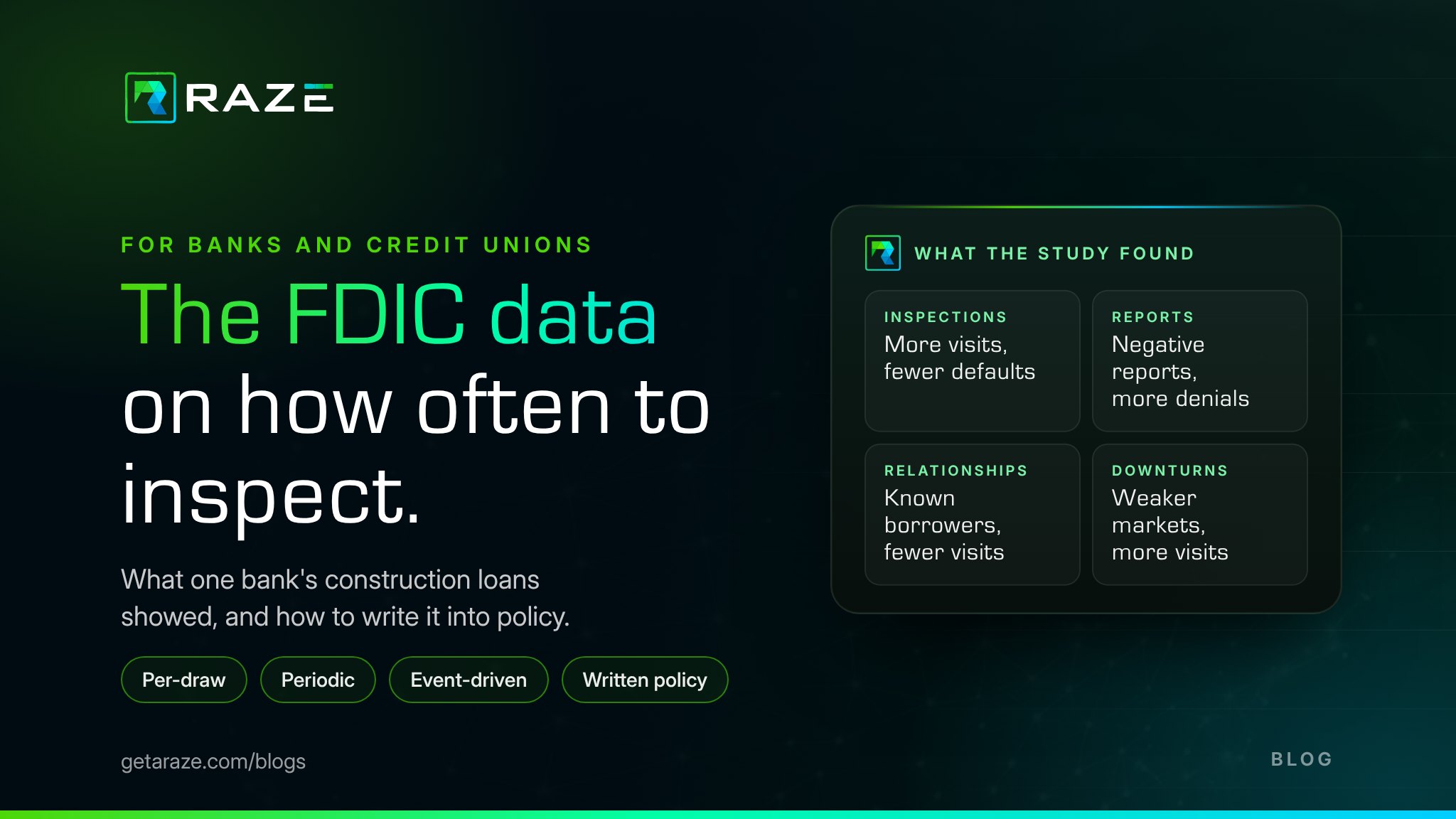
- More inspections, fewer defaults. Loans inspected more often were less likely to default. In the authors' estimate, moving from roughly two to three inspections per 100 days is associated with a 3.64 percentage point lower probability of default.
- Reports change decisions. A negative inspection report was associated with a higher likelihood that the bank denied the draw request. The inspection worked as a decision input, not a formality.
- Banks inspect selectively. The bank inspected less often when it already had a relationship with the borrower, and more often when the local economy weakened.
What it does not say
It does not set a schedule. No federal rule sets a fixed inspection interval for construction loans, and the paper does not propose one. Examiners look at whether the controls fit the lending: the FDIC's construction and land development examination procedures ask whether inspectors are qualified and independent of the lending function, whether reports are detailed enough to support disbursements, and whether funds go out only after written inspection reports are reviewed. See how examiners review construction loan monitoring.
It also does not say that more is always better. The finding describes inspection intensity on one bank's book; the cost of each visit, the size of the draw and the borrower's track record still decide where an extra inspection earns its place.
Turning the research into a policy
Make per-draw the baseline
Inspect before every disbursement. It ties each advance to documented work and matches the most common residential practice, so the number of inspections follows the number of draws.
Add a calendar visit for quiet loans
A loan that stops requesting draws can be a stalled loan. Set an interval for a progress inspection when no draw has come in, and write the interval down.
Name the events that trigger an extra visit
Write down the events that call for an extra visit: large change orders, missed milestones, stored-materials requests, complaints and a weakening local market. The study's bank inspected more in local downturns; a written trigger turns that into a rule instead of a reaction.
Decide how relationships change the schedule
The study's bank inspected borrowers it already knew less often. If your policy allows fewer visits for experienced builders, say which criteria qualify and review them each year, so fewer visits are a decision rather than a drift.
Keep the record
Keep every inspection, report and funding decision on the loan in one place. A schedule only helps if an examiner or a workout team can see that it was followed.
Where RAZE fits
RAZE treats per-draw, periodic and event-driven inspections as the same order with a different trigger. Lenders place each one in the Ordering Engine, through the RAZE API or from an AI assistant through the RAZE MCP. Your own inspectors can take an order through Direct Request, and RAZE Marketplace inspectors cover any U.S. address, on one report standard.
Through RAZE, a residential draw inspection is a flat $125 per single-family inspection when RAZE sends the inspector, or $25 per request with your own inspector, so each visit the policy adds has a known price. See the RAZE Rate Card.
Frequently asked questions
Keep reading
How often are draw inspections required?
The short answer, with the sources behind it.
How examiners review construction loan monitoring
What the FDIC, OCC and NCUA procedures look at.
Draw inspection checklist for each build stage
What the inspector documents at each stage of the build.
Dead days: the interest hiding in your draw cycle
What a waiting draw costs, and where to find it.
See every inspection on one record
Per-draw, periodic and event-driven inspections are ordered the same way and reported to one standard.
For Lenders
See the inspection history on a project in your book, from order to delivered report.
Request a DemoThe Rate Card
Residential draw inspection pricing for any U.S. address, with the commercial terms.
See the rate cardMore inspections meant fewer defaults.Write your schedule down.
Put every inspection on one record.
Request a Demo