Self-Inspection Draws vs. Third-Party Inspections
A borrower sends twelve photos of new drywall and asks for the draw by Friday. The lender has to decide whether those photos are enough to fund, or whether the draw waits for an inspector to visit the site.
Both answers can be right. A self-inspection draw and a third-party draw inspection are tools for different draws, and one lending program can use both. This guide covers how to decide which draw gets which, the rule to write before the first one, and how to keep both on one record. Each lender sets its own policy; nothing here replaces it.
Two ways to verify the same draw
In a self-inspection draw, the borrower or builder captures the evidence and the lender's team reviews it. In a third-party inspection, someone independent of the request visits the site and reports what is in place. The first trades some independence for speed and cost; the second costs a visit and buys an independent observer. Live video with a reviewer directing the camera, often called a remote draw inspection, sits between the two.
The choice matters because a construction loan's collateral is built one draw at a time. The NCUA's examiner guide notes that the full value of the collateral does not exist when the loan is granted; it is created as the improvements go in. The same guide lists the risks a lender monitors along the way, among them inappropriate use of loan proceeds, failure to complete, failure to build to specifications and cost overruns. Every draw should rest on evidence that the work it pays for is really there.
Bank examiners look at the people behind that evidence as well. The FDIC's construction lending examination procedures ask whether the individuals conducting inspections are qualified, whether they are rotated or independent of the lending function, and whether spot checks are made of the inspectors' work. A self-capture program has to answer the same questions in its own terms.
When each one fits
| The draw | Self-capture often fits | A third-party inspection usually fits |
|---|---|---|
| Size | Self-capture often fitsSmall relative to the loan, where a visit costs more than the risk it controls | A third-party inspection usually fitsLarge draws, where an error moves real money |
| Stage | Self-capture often fitsInterior finish, cosmetic rehab and other work that photographs clearly | A third-party inspection usually fitsThe first draw, the final draw and any work about to be covered |
| Materials | Self-capture often fitsInstalled work only | A third-party inspection usually fitsStored materials, where quantity, location and condition all count |
| Borrower | Self-capture often fitsAn experienced borrower with clean prior draws | A third-party inspection usually fitsA new borrower, or any draw after an exception or a missed milestone |
| Evidence | Self-capture often fitsPhotos that match every budget line in the request | A third-party inspection usually fitsMissing views, a mismatch with the budget, or a question about the property itself |
Read the table as a starting point, not a rule. A small draw for stored lumber still needs someone to count it, and a large draw for paint on a long-time borrower's project may not. The lender's credit policy decides; the table only shows where the evidence tends to hold up. For how often to inspect at all, see construction loan inspection frequency.
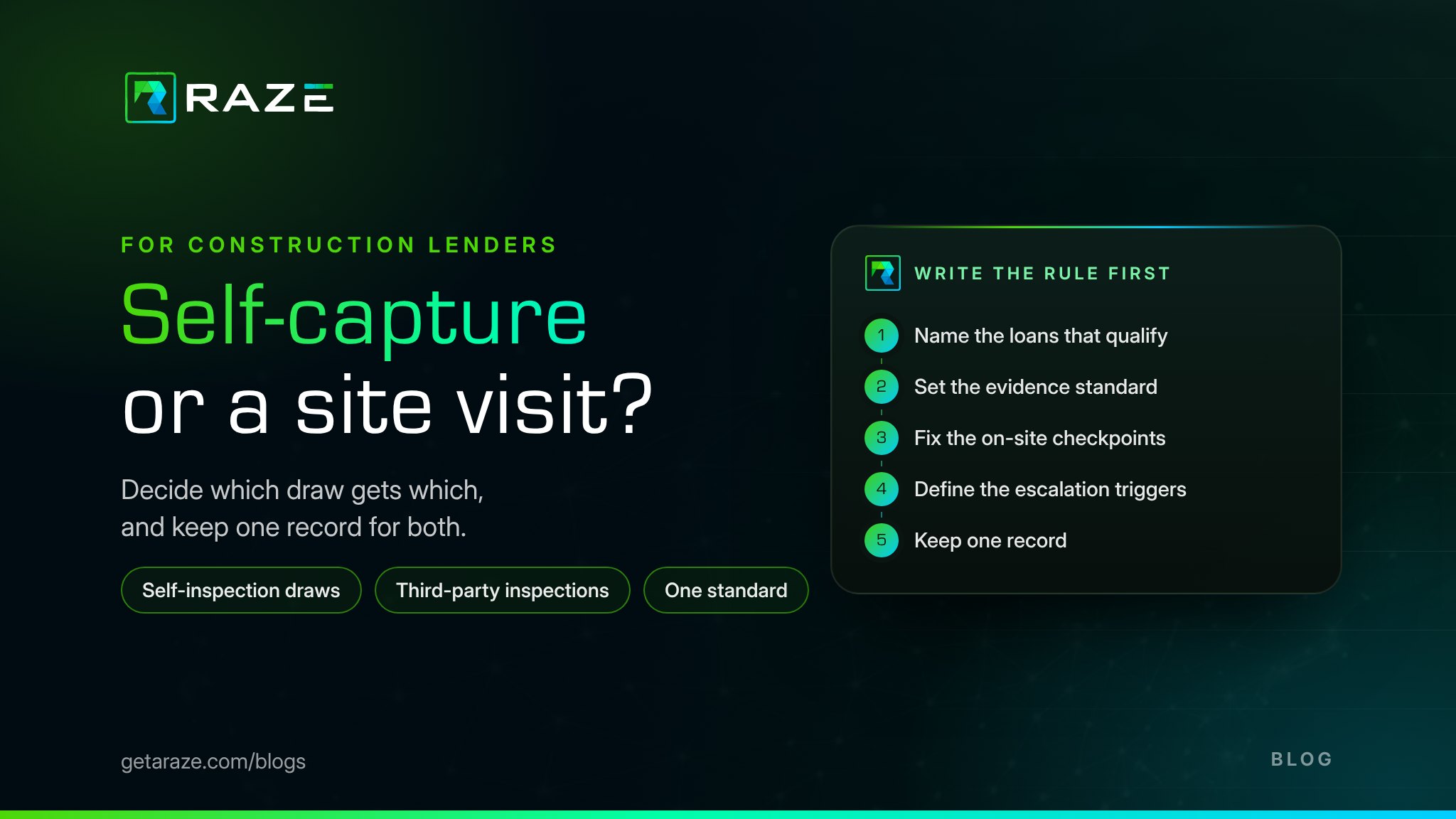
Write the rule before the first draw
Name the loans that qualify
Set the programs, draw sizes and borrower history that may use self-capture. A borrower who asks to inspect their own draw gets a straight answer from the policy, not a judgment call.
Set the evidence standard
List the required views for each budget line, require capture inside an app with date and time stamps and location data, and name the person responsible for each submission. See draw inspection photo requirements.
Fix the on-site checkpoints
Decide in advance which draws always get a visit: the first draw, work about to be covered, stored materials and the final draw.
Define the escalation triggers
Photos that do not support the request, a missed milestone, a change order or an exception send the next draw to an independent inspector. When an inspection shows less work lists the lender's usual options.
Spot-check the program
Send an independent inspector to a sample of self-capture draws. The same logic the FDIC applies to inspectors applies here: someone checks the person who checks the work.
Keep one record
Store every submission, review decision and escalation in the loan file, in the same format as the site visits, so the history reads as one program.
The question is not who holds the camera.
It is who ordered the inspection, what it had to show, who reviewed it and where the record lives. A program that answers those four can use either path for the right draw.
Where RAZE fits
In RAZE, self-capture is a fulfillment choice inside the lender's workflow, not a substitute for one. The lender's team orders every inspection in the Ordering Engine and sets the required questions and photos. For self-capture, the lender sends a Direct Request to the borrower or general contractor, who completes it in the RAZE Mobile App. For a third-party inspection, the order goes to a background-checked RAZE Marketplace inspector, or to the lender's own inspector through Direct Request.
Every path produces the same report. Photos carry GPS coordinates, date and time stamps and the device behind them, and they link to the draw sheet line items they support. When a self-capture draw trips an escalation trigger, the next order goes to an inspector without leaving the loan's record. The result is a file built to support audit and exam review, whichever path each draw took.
Third-party inspections through RAZE are priced on the RAZE Rate Card: a flat $125 per single-family inspection when RAZE sends the inspector, or $25 per request with your own inspector, at any U.S. address. See the RAZE Rate Card. RAZE documents the work; the lender reviews every report and decides what it supports. More on the full workflow: RAZE draw inspections and the draw inspection FAQs.
Frequently asked questions
Keep reading
What is a self-inspection draw?
The short answer, and where it fits.
Can a borrower do their own draw inspection?
Why lenders keep the inspection independent.
What is a remote draw inspection?
Live video and photos reviewed off site.
Marketplace vs. Direct Request
The two ways an order reaches the field.
One standard for every draw
Self-capture and site visits arrive in the same report, under the same required questions and photos.
For Lenders
See a Direct Request and a Marketplace inspection side by side on a project in your book.
Request a DemoThe workflow
How RAZE orders, captures and reports residential draw inspections.
See the draw inspection workflowWho holds the camera matters less than the rule.Write the rule before the first draw.
Run self-capture and site visits on one standard.
Request a Demo