The inspection shows the work
Percent complete by draw sheet line, materials on site noted apart from installed work, and photos of what the draw pays for.
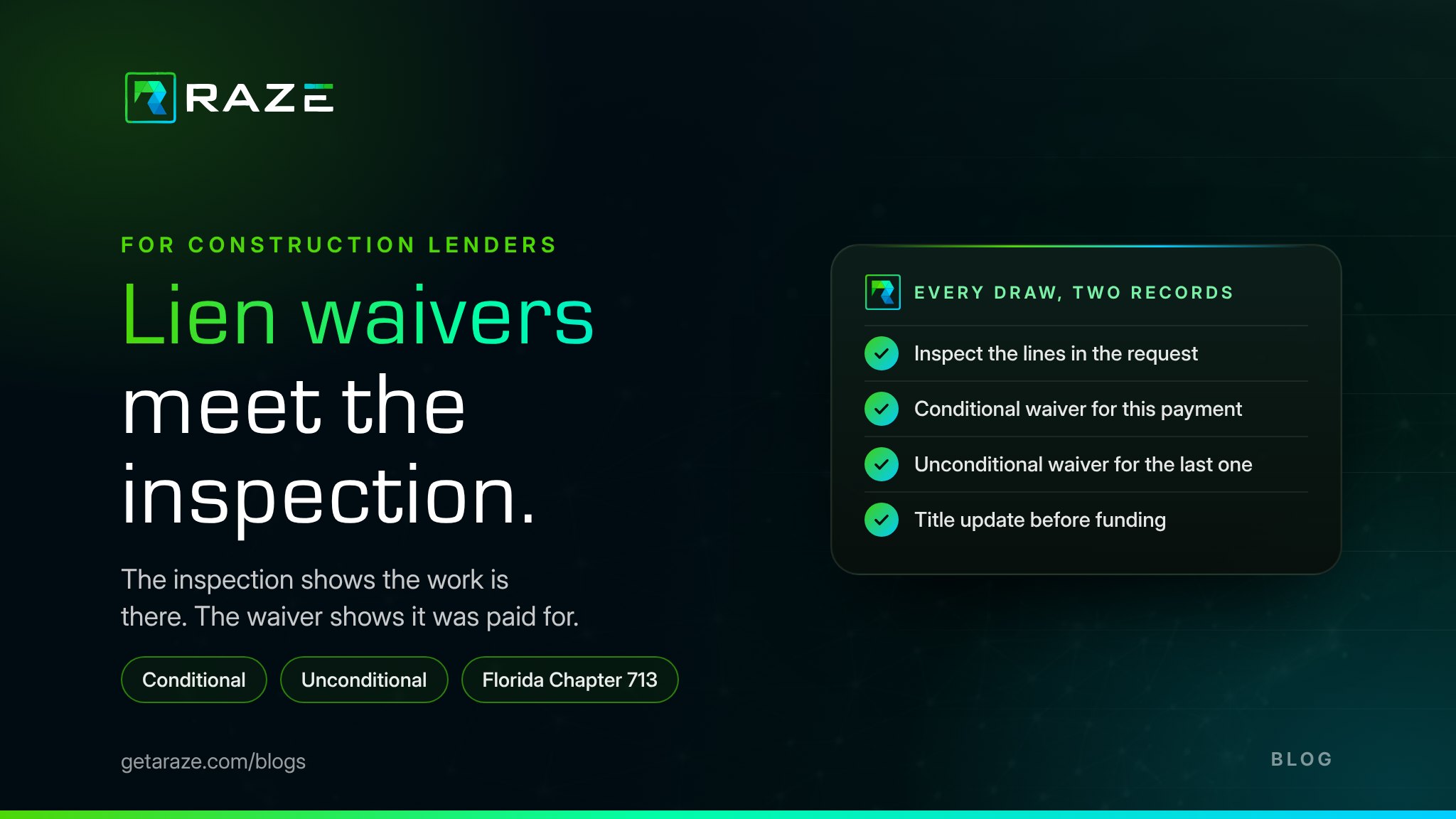
The inspection report says the roof is complete. The roofer says the general contractor never paid for it out of the last draw. Both can be true at once, and that gap is where a mechanics' lien starts.
A draw inspection and a lien waiver answer different questions. The inspection shows the work is in place; the waiver shows the people who did it were paid. This guide covers how lenders run the two together on each draw, which waiver fits which moment, and how Florida's construction lien law shapes the routine. For the definitions, see what a lien waiver is and when it is required. It is general information, not legal advice; lien law varies by state, so confirm the requirements with counsel.
Work in place but unpaid can still produce a lien. Paid work that is not in place is a draw ahead of progress. A lender needs evidence against both, which is why supervisors look at lien controls and inspections side by side.
The FDIC's construction and land development examination procedures ask whether lenders obtain lien waivers as work is completed and before funds are disbursed, and whether lien searches or title updates are made before each advance. The OCC's Comptroller's Handbook lists lien searches before disbursement among effective construction lending controls.
Keep a list of the general contractor, subcontractors and suppliers on the job. In Florida, notices to owner add to it as they arrive (Florida section below).
The inspector reports percent complete on each line the draw asks for, with photos, so you know whose work the advance pays for.
A conditional waiver for the payment this draw will make, and an unconditional waiver for the payment the last draw made, from each party it paid.
A line reported complete should be followed by a waiver from the trade that did it. A missing one is a question to ask before the next draw, not after the last.
A title update or lien search shows anything recorded since the last advance, while there is still an undisbursed balance to hold.
Final waivers from the general contractor and the major trades, as in the final draw checklist.
| Moment in the loan | Waiver lenders commonly ask for | What it covers |
|---|---|---|
| Draw request | Waiver lenders commonly ask forConditional progress waiver | What it coversThe payment this draw will make, effective once it clears |
| Next draw request | Waiver lenders commonly ask forUnconditional progress waiver | What it coversThe payment the previous draw made, confirmed as received |
| Final draw request | Waiver lenders commonly ask forConditional final waiver | What it coversThe final payment, effective once it clears |
| After the final payment | Waiver lenders commonly ask forUnconditional final waiver | What it coversThe whole job, confirmed as paid |
Florida's construction lien law, Chapter 713 of the Florida Statutes, puts several steps on the calendar of a residential construction loan.
The notice of commencement. A lender must record the notice of commencement before disbursing any construction funds to the contractor, and a lender that fails to is liable to the owner for the resulting damages; posting it on site stays the owner's job (section 713.13). The notice expires one year after recording unless it states a different date, so watch it on a build that runs long.
Notices to owner. A subcontractor or supplier without a direct contract with the owner generally serves a notice to owner before it starts, or within 45 days after it starts, and in any event before the owner's final payment after the contractor's affidavit; failing to serve it on time is a complete defense to its lien (section 713.06). Those notices tell you whose waivers to collect.
The contractor's final payment affidavit. Before final payment, the contractor gives the owner an affidavit stating that every lienor who timely served a notice has been paid, or naming each one who has not and the amount due, and the final payment is held until it is furnished (section 713.06).
The waiver forms. Florida sets out progress and final payment waiver forms, and a lien right cannot be waived before the work is done (section 713.20). Other states differ on all four points.
An unconditional waiver can only confirm a payment already made, so the waiver for this draw's work arrives with the next request. Track which lines are still waiting for one.
Percent complete by draw sheet line, materials on site noted apart from installed work, and photos of what the draw pays for.
Who was paid, for which payment or period, and whether the release depends on the payment clearing.
Any lien or claim recorded against the property since the last advance, before the next one funds.
A draw inspection reports what is on site. Collecting waivers, ordering the title update and deciding what funds stay with the lender.
RAZE documents the work side of each draw. The inspector reports percent complete on each draw sheet line in the RAZE Mobile App, with photos linked to the lines they support and GPS coordinates and date and time stamps on every photo, and each inspection keeps its status history. That gives your reviewer a dated record of whose work was in place at each draw to match against the waivers. Lien waivers stay in your draw review or loan administration system, and RAZE integrates with existing construction loan administration workflows.
Through RAZE, a residential draw inspection is a flat $125 per single-family inspection when RAZE sends the inspector, or $25 per request with your own inspector, at any U.S. address. See the RAZE Rate Card.
What is a lien waiver?
Conditional, unconditional, progress and final.
Final draw on a construction loan: what to collect
The completion inspection, waivers and retainage.
Owner-builder loans: draw controls
Waivers when there is no general contractor.
What is retainage in construction lending?
The share held back until completion.
A dated, line-by-line record of the work behind each payment, on every draw.
See a draw inspection on a project in your book, from order to delivered report.
Request a DemoMatch every waiver to inspected work.
Request a Demo