Final Draw on a Construction Loan: What to Collect
The house looks finished, the builder wants the last check, and the file is still missing two lien waivers. The final draw on a construction loan is the lender's last point of leverage: once it funds, there is no undisbursed balance left to hold.
It usually releases the last budget lines and any retainage held along the way, so it carries more conditions than any draw before it. This guide covers what to collect, what the completion inspection documents and how to handle an open punch list. It is general information, not legal advice; lien and retainage law varies by state.
What makes the final draw different
Interim draws pay for progress. The final draw pays for completion, so it closes three things at once: the last budget lines, any retainage held from earlier payments, and the lender's ability to withhold funds until the project is finished. On a construction-to-permanent loan, it usually comes just before the loan converts to its permanent phase.
Supervisors look at this step closely. The FDIC's construction and land development examination procedures ask whether lenders obtain lien waivers as work is completed and before funds are disbursed, and whether they confirm a certificate of occupancy before the final disbursement.
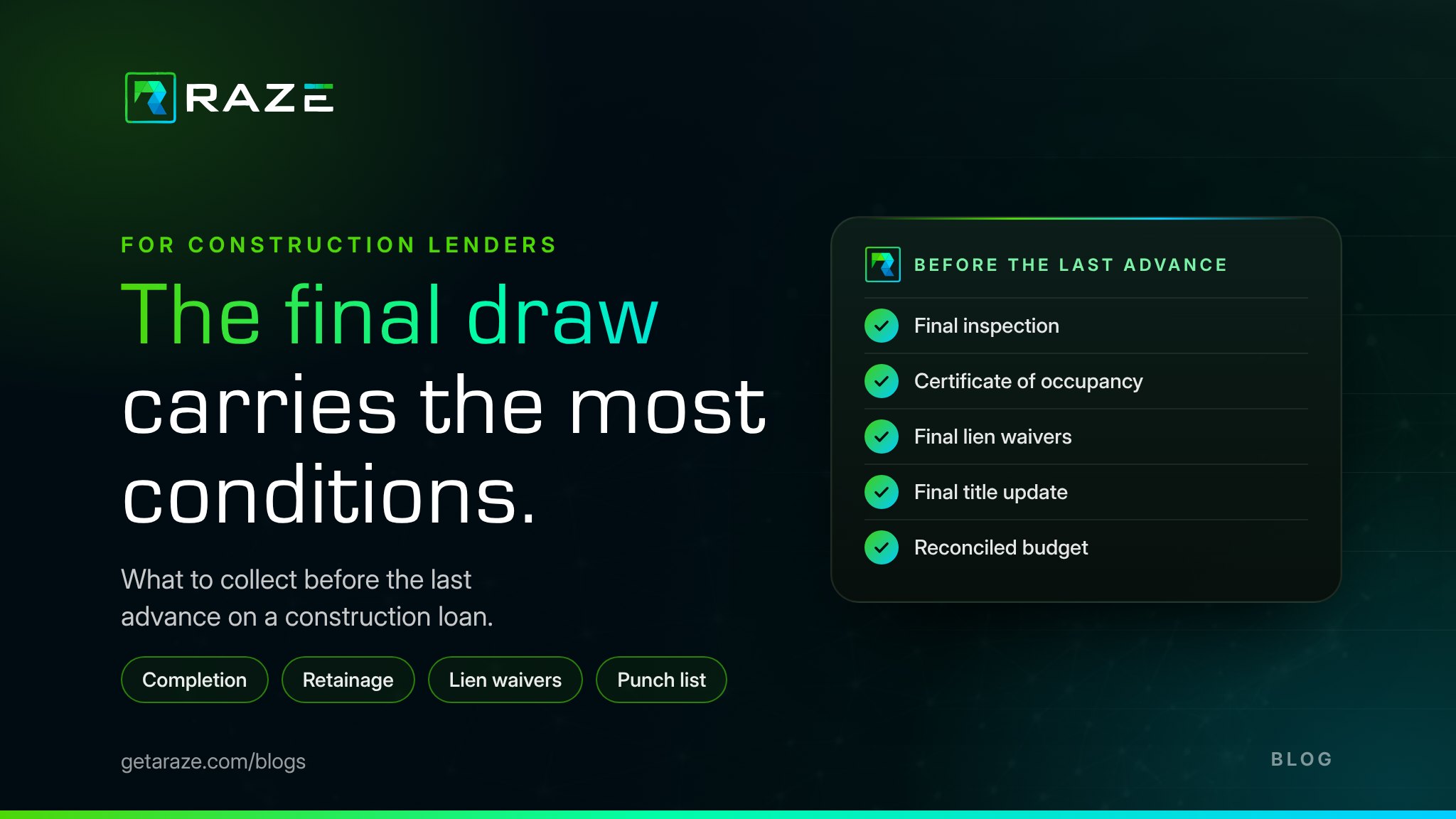
What to collect before the last advance
A final inspection at 100 percent
Document every draw sheet line as complete, with photos, plus anything the lender's final-inspection checklist adds. Draw inspection vs. final inspection explains what changes on the last visit.
The certificate of occupancy
Get the certificate, or the jurisdiction's equivalent final approval, where one is issued. The inspector documents the work; the building department approves it.
Final lien waivers
Collect them from the general contractor and the major subcontractors and suppliers, matched to the final payment. See lien waivers for construction draws.
A final title update
Run a search for liens recorded since the last advance, before the title insurer extends coverage to the final draw.
A reconciled budget
Confirm that every line is at 100 percent, every change order is approved, and the remaining balance matches the final request.
The punch list
Close the punch list, or list, price and photograph the open items so a holdback covers them until they are finished.
Retainage and the punch list
Retainage is the share of each payment held back until completion. Releasing it with the final draw is common, once the completion conditions in the construction contract and the loan agreement are met. See what retainage is in construction lending.
Open punch-list items are the usual sticking point. Some lenders fund the final draw and hold back an amount for the unfinished items, released after a follow-up inspection; others wait until the list is closed. Weather-dependent work such as landscaping or exterior paint is a common reason for a holdback. Either way, list, price and photograph the open items, so the follow-up inspection checks the same list.
The inspector documents; the lender decides.
A final inspection reports what is complete and what is not. Code approval belongs to the building department, and the funding decision belongs to the lender.
Where RAZE fits
In RAZE, interim draws and the final inspection run in the same workflow. The lender sets the final inspection's required questions and photos in the Ordering Engine, the inspector completes it in the RAZE Mobile App, and the report arrives in the same format as every draw before it, with percent complete by line and photos that carry GPS coordinates and date and time stamps.
Through RAZE, the final inspection is priced like every other residential draw inspection: a flat $125 per single-family inspection when RAZE sends the inspector, or $25 per request with your own inspector, at any U.S. address. See the RAZE Rate Card. RAZE documents the work; lien waivers, the title update and the funding decision stay with the lender.
Frequently asked questions
Keep reading
Draw inspection vs. final inspection
What changes when the inspection is the last one.
What is retainage in construction lending?
The share of each payment held until completion.
Lien waivers for construction draws
Conditional, unconditional, progress and final.
Construction loan draw fees: what each line pays for
The inspection, title update, disbursement and administration lines.
Close out the loan on one record
The final inspection arrives in the same format as every draw before it, so the file reads as one history.
For Lenders
See a completion report on a project in your book, from order to delivered report.
Request a DemoThe Rate Card
Residential draw inspection pricing for any U.S. address, with the commercial terms.
See the rate cardThe last draw carries the most conditions.Collect them all before it funds.
Close out every loan on one record.
Request a Demo