Construction Loan Draw Fees: What Each Line Pays For
A builder calls about draw four. The wire landed short of the request, and the person who answers has to open three documents to explain why.
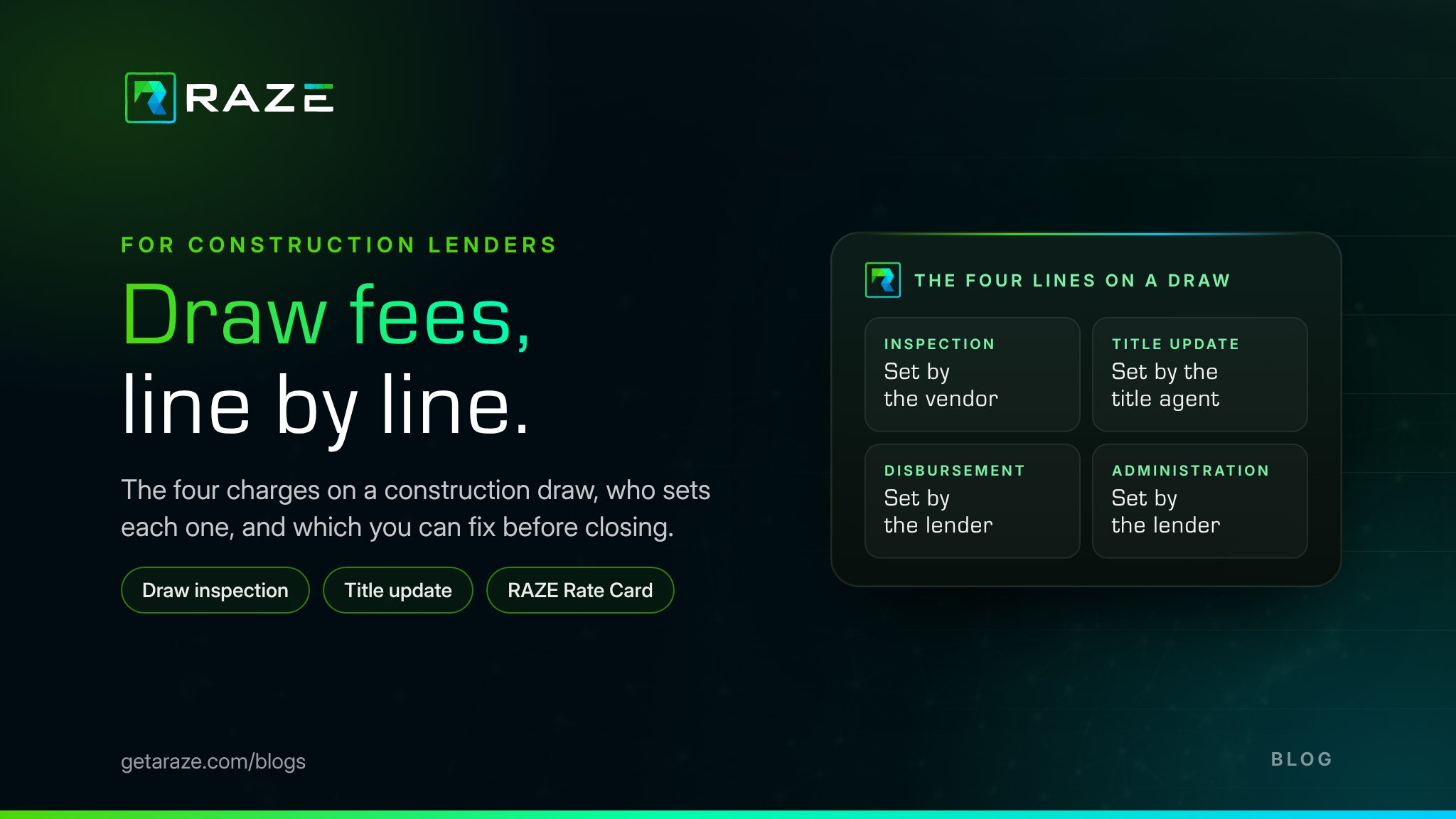
Construction loan draw fees are the charges a lender collects each time it releases a draw. Most draws carry some mix of four: the draw inspection, a title update, a disbursement fee and the lender's own administration fee. Each pays for different work, each is set by a different party, and two of them are priced outside the lender altogether. A draw fee schedule that names all four, with who sets each one, answers that phone call before it happens.
The four lines on a draw
| Line | What it pays for | Who sets the price |
|---|---|---|
| Draw inspection | What it pays forA site visit that documents the work in place against the draw request, with photos and percent complete by budget line item | Who sets the priceThe inspection vendor; the lender passes the fee through or absorbs it |
| Title update | What it pays forA search for liens or other matters recorded since the last draw, before the title insurer extends coverage to the new advance | Who sets the priceThe title agent or insurer, under its own rate schedule |
| Disbursement | What it pays forMoving the funds by wire or other transfer to the borrower, the builder or an escrow | Who sets the priceThe lender or its bank |
| Draw administration | What it pays forThe lender's own work on the request: checking it against the budget, collecting lien waivers, approving and booking the advance | Who sets the priceThe lender, in its fee schedule |
Not every loan carries all four. Some lenders fold administration and disbursement into a single draw fee, and some absorb the inspection for certain programs. The title update is the line supervisors look for: the FDIC's construction lending examination procedures check that disbursements are made only after inspection reports, lien searches and title updates are reviewed, and the NCUA's examiner guide describes a date-down endorsement before each advance confirming no intervening liens.
Which lines you can fix before closing
The administration and disbursement fees are yours, so they are as predictable as your own fee schedule. The title update follows the title agent's schedule. The inspection depends on the vendor: a vendor that quotes by address, prices a rural county higher or charges extra for a rush leaves the fee sheet holding an estimate.
A standard residential draw inspection typically costs $100 to $300 per site visit in the U.S., and rural or rush inspections often cost more. RAZE charges one flat $125 per single-family inspection at any U.S. address when RAZE sends the inspector, or $25 per request when your own inspector does the work.
With a published rate, the inspection line on the fee sheet is the number on the invoice. Re-inspections you request are billed at the same rate, so a second visit is one more line at a known price rather than a new quote. See the full RAZE Rate Card.
RAZE Rate Card
Any U.S. address, including Alaska and Hawaii
Marketplace
$125
per inspection, single-family
Direct Request
$25
per request, any residential property
Where draw fees grow
Draw fees usually grow through events the fee sheet did not plan for:
- A second visit. A draw requested before the work is in place means another inspection and another fee. Decide in the loan agreement who bears it, and see when a reinspection is needed.
- A new market. A fee sheet built on your home county understates the rest of the book when the vendor prices by location. A rate that is the same at any address keeps one estimate for every loan.
- The days in between. A slow draw also has a cost that never appears on the fee sheet: the days between the request and the funding. Dead days shows how to measure them.
What a clear draw fee schedule says
Name every line
List each charge a draw can carry, using the same name the borrower will see on the disbursement statement.
Say who sets each one
Mark which fees are yours and which come from a vendor or the title agent, so a question about a third-party charge reaches the right desk.
Say when each is collected
At closing, from each draw or invoiced separately. For the inspection fee, see who pays for a draw inspection.
Write the re-inspection rule
State who pays for a second visit when the work is not ready, and how the borrower is told before the next draw.
Disclose from the draw schedule
On consumer-purpose construction loans, Regulation Z treats inspection and handling fees for staged disbursements, draw fees included, as loan costs (comment 37(f)-3). Fees collected at or before consummation go in the Loan Costs table; fees collected after closing are totaled on an addendum headed "Inspection and Handling Fees Collected After Closing." When the number of draws is not yet known, the rule asks for the best information reasonably available. Our recommendation: use the draw schedule in the loan agreement times a published per-inspection rate, and re-run that figure whenever the schedule changes. Have compliance counsel confirm the treatment for each program.
Where RAZE fits on the fee sheet
RAZE prices one line: the draw inspection. Your administration fee, the wire and the title update stay with you and your title agent.
RAZE invoices the lender once a month, net 30, with no monthly minimum and no platform fee, and the lender decides how the cost flows to the loan. In residential programs, inspection costs may be incorporated into borrower closing costs, subject to lender policy and applicable requirements. The rate is the same whether you order in the Ordering Engine, through the RAZE API or from an AI assistant through the RAZE MCP. See what the $125 buys.
Frequently asked questions
Put one price on the inspection line
Three of the four lines are yours or your title agent's. The fourth can be on a published Rate Card.
For Lenders
See the inspection line on a project in your book, from order to delivered report.
Request a DemoThe Rate Card
Residential draw inspection pricing for any U.S. address, with the commercial terms.
See the rate cardFour lines on every draw.One of them is on the Rate Card.
Put one price on the inspection line.
Request a Demo