Percent complete by line
Progress against each budget line, with photos for the lines the draw requests, so the reviewer can compare the request line by line.
On an owner-builder loan, the person requesting the draw is the person who manages the work and pays the trades. There is no general contractor between the borrower and the subcontractors, so one of the usual checks on a draw request is missing.
That gap is why owner-builder files need tighter draw controls than a contractor-built loan. This guide covers what changes when the borrower is the builder, the controls that hold up, and what each inspection should record. It is general information, not legal advice. Whether an owner-builder loan fits a program is the lender's decision, and lien law varies by state, so confirm the requirements with counsel.
On a contractor-built loan, the general contractor manages the trades, pays them and collects their lien waivers. On an owner-builder loan, the owner does all three. The borrower who benefits from each advance is also the person who reports the progress behind it.
Three risks follow. Progress claims are self-reported. Lien exposure is spread across many direct payments to subcontractors and suppliers, with no contractor's waiver covering the whole job. Schedule and budget depend on the owner's own experience, and no contractor is bound by a construction contract to finish the work.
Some states put the role in writing. Florida, for example, has an owner-builder sign a disclosure statement before a building permit issues, acknowledging that they are the responsible party of record on the permit and must provide direct, onsite supervision of the construction (section 489.103(7), Florida Statutes). Rules in other states differ.
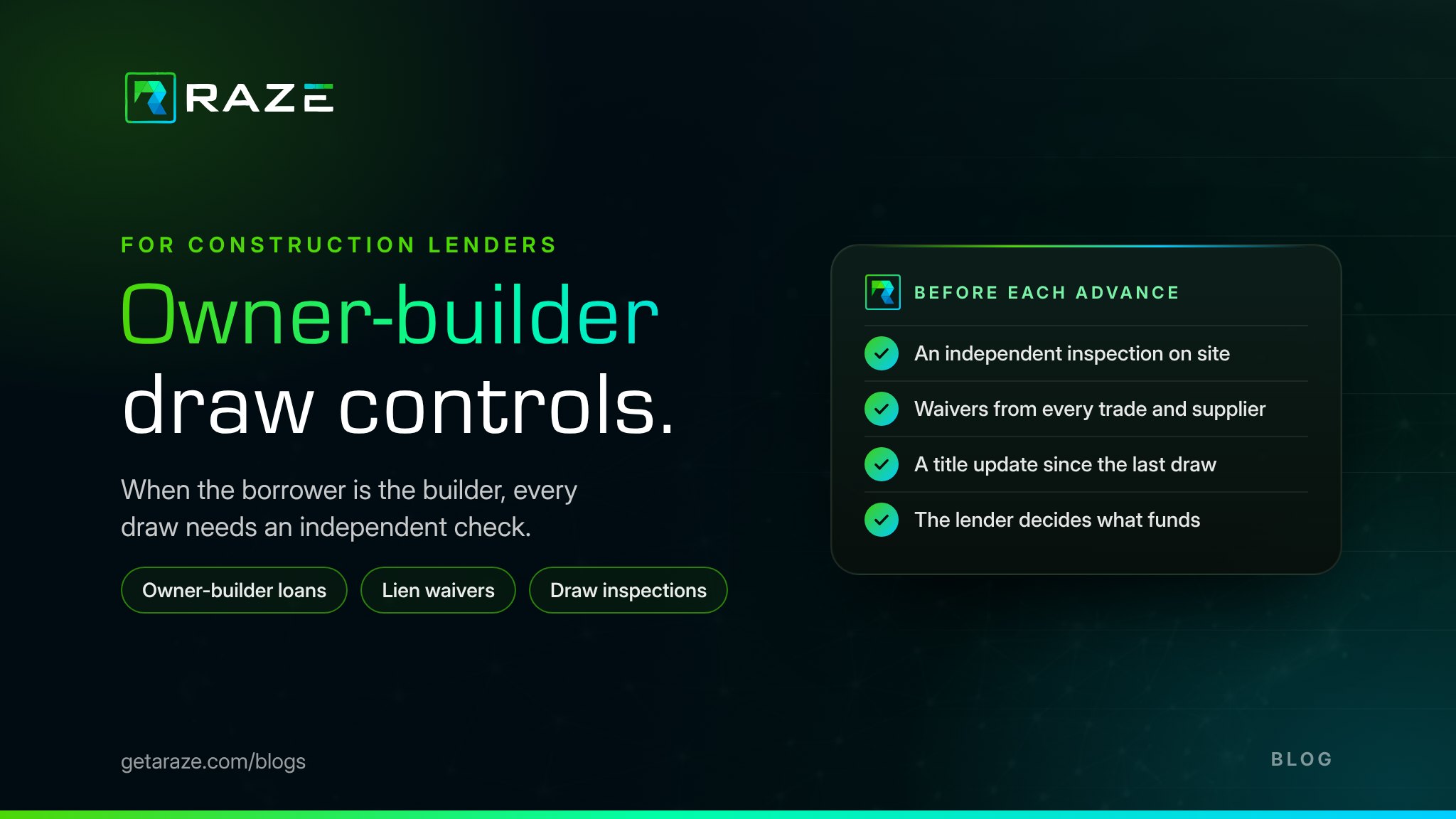
Order an inspection before each draw, not only at milestones, and vary the timing where your policy allows. The FDIC's construction and land development examination procedures ask whether inspections are made on an irregular schedule and before draw requests.
A borrower's own photos can support a status check, but the person documenting progress on an owner-builder loan should not be the person the draw pays. The same FDIC procedures look for inspectors who are qualified and independent of the lending function. Can a borrower do their own draw inspection? covers when self-capture fits.
With no general contractor, no single waiver covers the job. Collect conditional waivers for the current payment and unconditional waivers for prior payments from each subcontractor and supplier the owner pays. See lien waivers for construction draws.
On large lines, consider joint checks or payment directly to the subcontractor or supplier. The FDIC procedures list direct payments to subcontractors among the disbursement controls examiners look for.
A lien search or title update before each disbursement shows any lien recorded since the last one, while there is still an undisbursed balance to hold.
Owner-builders often buy materials directly. Pay for installed work, and treat materials on site under your stored-materials policy. See stored materials in a construction draw.
The FDIC procedures warn that front loading overstates the cost of work completed early, which can leave too little money to finish the project. Compare each draw with the budget line, not only with the total.
Progress against each budget line, with photos for the lines the draw requests, so the reviewer can compare the request line by line.
Materials delivered but not installed are noted apart from installed work, so the lender applies its stored-materials policy to them.
Items an owner-builder policy may ask for, such as a posted permit or work that looks out of sequence, recorded as answers with photos.
When the inspection does not support the amount requested, the lender decides what funds. See what happens when an inspection shows less work for the usual options. For how often to inspect in general, the FDIC research on inspection frequency is the place to start.
A draw inspection reports what is on site. Lien waivers, the title update and the decision to fund stay with the lender.
In RAZE, the lender sets the required questions and photos in the Ordering Engine, and each assignment reaches the inspector with those requirements attached, so the items your owner-builder policy adds travel with every order. The inspector completes them in the RAZE Mobile App. Photos carry GPS coordinates and date and time stamps and link to the draw sheet line items they support, and every report on the loan arrives in the same format, with its status history.
Through RAZE, an owner-builder project is priced like any other residential draw inspection: a flat $125 per single-family inspection when RAZE sends the inspector, or $25 per request with your own inspector, at any U.S. address. See the RAZE Rate Card. RAZE documents the work; waivers, the title update and the funding decision stay with the lender.
Can a borrower do their own draw inspection?
When self-capture fits and when it does not.
Lien waivers for construction draws
Conditional, unconditional, progress and final.
Construction loan inspection frequency: FDIC research
What the FDIC researchers found about inspection timing.
Final draw on a construction loan: what to collect
The completion inspection, waivers and retainage.
One independent report per advance, in the same format for the whole loan.
See a draw inspection on a project in your book, from order to delivered report.
Request a DemoPut an independent inspection on every draw.
Request a Demo