Marketplace vs. Direct Request for Draw Inspections
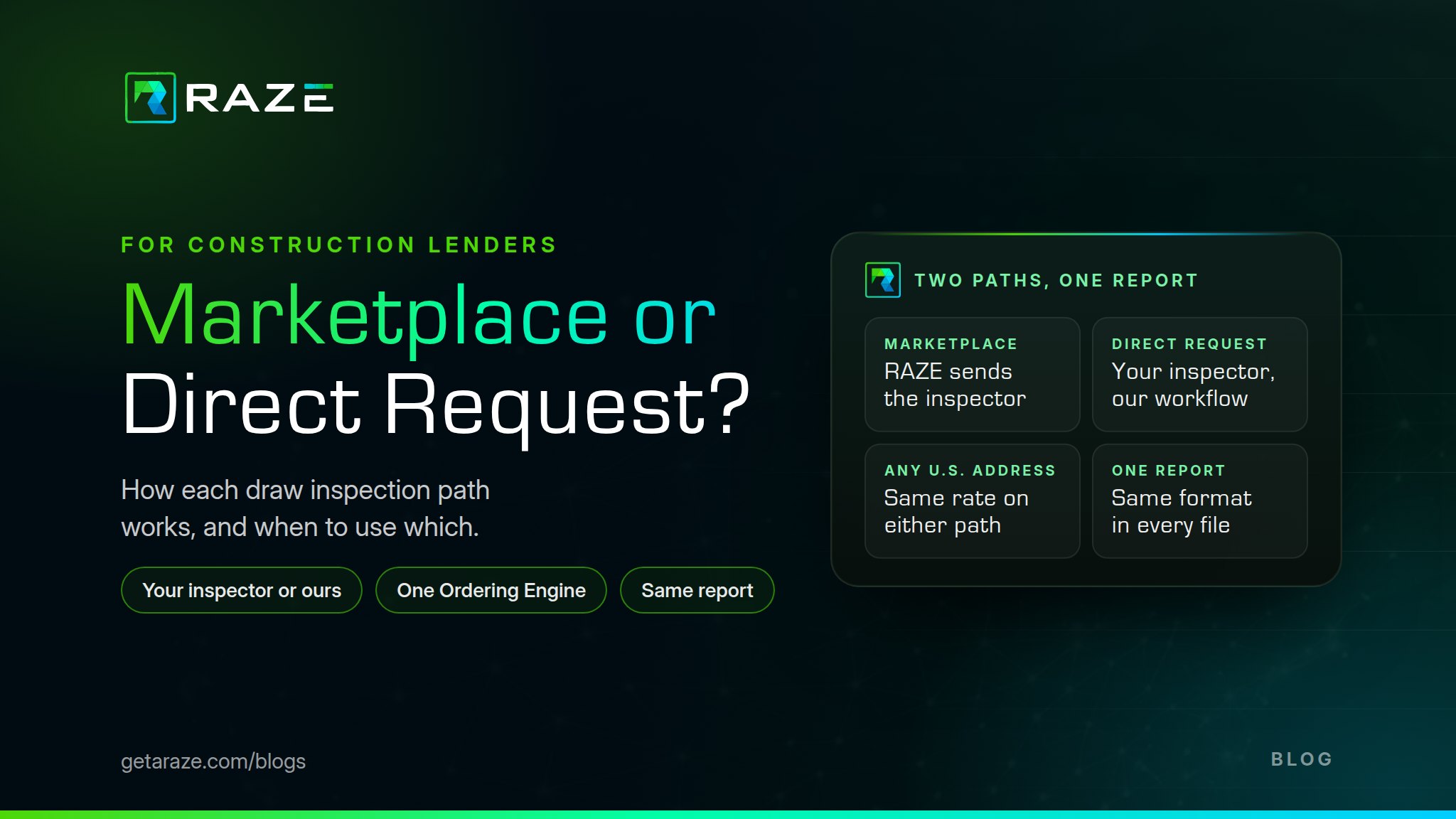
Every draw inspection ordered through RAZE is fulfilled one of two ways. Marketplace is RAZE-managed fulfillment: RAZE sends a background-checked inspector from the RAZE Inspection Network, at $125 per single-family inspection at any U.S. address. Direct Request is lender-directed fulfillment: your own staff or a vendor you already work with performs the inspection, ordered and standardized through RAZE, at $25 per request, and you pay your inspector directly.
Both paths run through the same Ordering Engine, the same RAZE Mobile App in the field, and the same standardized report in your loan file. What changes is who performs the inspection, who manages that relationship, and what you are optimizing for: coverage, control, cost, or all three.
This guide explains how each model works, the advantages and trade-offs of each, and a short framework for deciding which to use on a given order, market or portfolio. Most lenders end up running both, and the workflow is built so they can.
The short answer
Use Direct Request wherever you already have a qualified inspector or preferred vendor and want to keep that relationship and that rate. Use Marketplace wherever you do not: a new state, a rural county, a volume spike, or any order your own resources cannot take on time. Turn on both, set your routing rules, and let each order pick its path.
Fulfillment models, one Ordering Engine
U.S. address with draw inspection coverage
Standardized report in every loan file
What the RAZE Marketplace is
The RAZE Marketplace is managed fulfillment through the RAZE Inspection Network. When an order is routed to Marketplace, RAZE assigns an inspector by location, availability, experience and the rules your institution has configured, manages the assignment through to report delivery, and reviews the report before it reaches you.
The network is not an open crowd. Every inspector and inspection firm passes the same published screening before any assignment is visible: identity verification, a competency assessment, watchlist and AML screening, and proof of insurance. On residential draw inspections, RAZE averages 1.1 days from request to submission nationwide.
For a lender, the practical effect is coverage without vendor management. You do not find, screen, contract or chase an inspector in a market where you have none. You place the order, RAZE fulfills it at the published rate, and the report arrives in the same format as every other inspection in your portfolio.
Marketplace
RAZE-managed fulfillment
Coverage on demand. RAZE screens, assigns and manages the inspector; your team orders and reviews. The inspection is captured in the RAZE Mobile App and delivered as a standardized report with the same audit trail as every other draw in your file.
Who performs
A background-checked inspector from the RAZE Inspection Network, assigned by location, availability, experience and your configured rules.
Who manages
RAZE: assignment, follow-up, reassignment and quality review.
What it costs
$125 per single-family inspection, plus $35 per additional unit, at any U.S. address including Alaska and Hawaii. No geographic or travel surcharge.
Best fit
Markets where you have no inspector, rural and remote properties, volume spikes, and orders your own resources cannot take on time.
Advantages of Marketplace fulfillment
Any U.S. address
Order in a new state or a rural county and the inspection is fulfilled at the same rate, including Alaska and Hawaii.
Screened before the first assignment
Identity verification, a competency assessment, watchlist and AML screening, and proof of insurance, followed by approval from RAZE.
RAZE handles the assignment
Routing, follow-up, reassignment and a quality review before the report reaches your queue.
No vendor panel to build
No sourcing, contracting or performance tracking in markets you rarely lend in.
Offline field capture
Inspectors keep capturing with no signal, and the app syncs everything once the device reconnects.
The same report
Your template, your questions and photo requirements, in the same format as every other inspection in your file.
Where Marketplace has trade-offs
Marketplace is the answer to a coverage problem. It is not automatically the answer everywhere.
- You are choosing a standard, not a person. RAZE assigns the inspector within your rules. If a specific relationship matters on a specific project, that is a Direct Request.
- It can duplicate a panel you already run. If your preferred vendors turn inspections quickly and cheaply in your core markets, routing those orders to Marketplace adds little. Keep the panel, and use Marketplace for what it cannot cover.
- Your negotiated rate may be lower. Direct Request charges $25 per request, and you keep paying your inspector at the rate you agreed with them. Where that rate is low, Direct Request can be the cheaper path.
What Direct Request is
Direct Request is lender-directed fulfillment. You decide who performs the inspection: an internal inspector, other lender personnel, or a preferred vendor you already contract with. RAZE does not choose the inspector. It gives that inspector a structured order in the Inspector Portal, the RAZE Mobile App for field capture, and the same report template everyone else follows. You pay your inspector directly; RAZE charges $25 per request for the software and the report.
This is the model for institutions that have inspection resources and want to keep them. It also answers the most common objection lenders raise when they evaluate inspection software: "We are not replacing our vendors." With Direct Request you do not. Your vendors keep the work. What changes is that every one of them now submits through one intake, one capture standard and one report format, which is what a reviewer, an auditor or an examiner needs to see.
Direct Request
Lender-directed fulfillment
Control with standardization. You keep the inspector relationship, the negotiated rate and the assignment decision; RAZE supplies the order, the mobile capture workflow and the standardized report, so the output matches the rest of your portfolio.
Who performs
Your internal staff or a vendor you select and contract with directly.
Who manages
Your institution: sourcing, contracting and vendor performance stay with you, and RAZE tracks status and service levels.
What it costs
$25 per request. You pay your inspector directly at the rate you agreed with them; RAZE adds no markup to it.
Best fit
Core markets with an established vendor panel, in-house inspection teams, and projects where a specific inspector relationship matters.
Advantages of Direct Request fulfillment
Keep the inspectors you trust
The vendors and employees you already use keep the work, at the rate you negotiated.
You pick the person
Assign the specific inspector or firm on every order, draw after draw.
One standard for everyone
Internal inspectors and outside vendors submit through one intake, one capture standard and one report format.
Vendor performance you can measure
Acceptance, scheduling, turnaround and revisions are tracked in one place instead of a dozen inboxes.
No disruption in your core markets
Borrower and builder relationships stay with the people who already hold them.
$25 per request
RAZE charges for the software and the report; your inspector is paid by you, with no markup.
Where Direct Request has trade-offs
Direct Request gives you control, and control has a cost.
- Coverage is yours to solve. If your vendor is unavailable, on vacation or two hundred miles away, the order waits unless you have a backstop. Marketplace is the backstop.
- Screening and performance management stay with you. RAZE standardizes what your vendor submits, but who is on your panel and whether they belong there is your call.
- Onboarding is real, if small. Each internal inspector or vendor is set up once in the Inspector Portal and the RAZE Mobile App before their first assignment. Many draw inspection vendors already work in the app.
One order, two paths
The models are not two systems. They are two routing destinations inside one workflow, and they differ at exactly one step: who gets the assignment. The order is created once, in the Ordering Engine, through the RAZE API or from an MCP-compatible AI assistant, with the project address and your template attached. Routing then sends it down one of two lanes, and both lanes end at the same report and the same audit trail.
One order screen
- Ordering Engine
- RAZE API
- RAZE MCP
Enter the project address and your template, then pick the path.
Marketplace
$125
RAZE sends the inspector.
per inspection, single-family
- RAZE assigns a background-checked inspector from the RAZE Inspection Network
- Photos, percent complete and notes in the RAZE Mobile App
- RAZE quality review before the report reaches your queue
Direct Request
$25
You send your inspector.
per request, any residential property
- Your inspector or vendor accepts the order in the RAZE Mobile App
- The same template, questions and photo requirements
- You pay your inspector directly
One standardized report
Geo- and time-stamped photos in your template, in the same format from either lane.
Your reviewer approves the draw.
Side by side
| Factor | Marketplace | Direct Request |
|---|---|---|
| Who performs the inspection | MarketplaceA background-checked inspector from the RAZE Inspection Network | Direct RequestYour internal staff or a vendor you choose |
| Who screens the inspector | MarketplaceRAZE: identity verification, competency assessment, watchlist and AML screening, proof of insurance | Direct RequestYour institution: your panel, your standards |
| Who manages the assignment | MarketplaceRAZE: routing, follow-up, reassignment and quality review | Direct RequestYou, with status and service levels tracked in RAZE |
| Coverage | MarketplaceAny U.S. address, including Alaska and Hawaii, at the same rate | Direct RequestWherever your staff and vendors already work |
| Inspector selection | MarketplaceAssigned by location, availability, experience and your rules | Direct RequestYou name the person or firm |
| What RAZE charges | Marketplace$125 per single-family inspection, plus $35 per additional unit | Direct Request$25 per request |
| Who pays the inspector | MarketplaceRAZE | Direct RequestYou, directly, at your negotiated rate |
| Setup | MarketplaceNo vendor setup | Direct RequestSet up each inspector or vendor once |
| Field capture | MarketplaceRAZE Mobile App | Direct RequestRAZE Mobile App |
| Report and audit trail | MarketplaceStandardized, geo- and time-stamped | Direct RequestStandardized, geo- and time-stamped |
| If the inspector cannot take it | MarketplaceRAZE reassigns within the network | Direct RequestYou reassign, or routing falls through to Marketplace |
| Best for | MarketplaceNew or rural markets, volume spikes, coverage gaps | Direct RequestEstablished panels, in-house teams, relationship-driven projects |
When to use Marketplace
Route an order, a market or a whole segment of the portfolio to Marketplace when the problem is coverage.
- New markets. You closed a loan two states away from your nearest inspector. Marketplace gives you a screened inspector there without opening a vendor search, at the same rate you pay at home.
- Rural and remote properties. Long drives and thin local supply are the norm. The rate is the same at any U.S. address, and offline capture means the report is complete even where the signal is not.
- Volume spikes. A builder program, a seasonal push or a portfolio acquisition adds draws faster than your panel can absorb. Marketplace flexes; a fixed panel does not.
- Your vendor is unavailable. They declined, missed the service level or went quiet. The order should fall through to Marketplace automatically rather than sit in someone's inbox.
- Vendor concentration. If one firm performs most of your inspections in a region, Marketplace is a ready alternative when you need one.
- Scopes outside your panel's specialty. Commercial draws, property condition assessments and other work your residential panel does not handle.
When to use Direct Request
Route to Direct Request when you already have the inspector and the problem is consistency, not coverage.
- Established preferred vendor panels. You have negotiated pricing, known quality and years of history. Keep it, and standardize the output.
- In-house inspection teams. Internal inspectors get structured orders, mobile capture and a report format that matches what your outside vendors produce.
- Relationship-sensitive projects. A repeat builder, a high-profile borrower, or a project where continuity from draw to draw matters.
- Policy or program requirements. Some programs require, or your credit policy prefers, that a designated employee or approved firm performs the inspection. Direct Request satisfies that without a separate process.
- High-density local volume. In a market where your panel turns inspections quickly and cheaply, there is no reason to change what works.
Using both
The models are not a fork in the road. They are two routing destinations inside one workflow, and the strongest configuration uses both:
- Direct Request as the default in core markets. Orders route to your preferred panel or internal inspectors first.
- Marketplace as the automatic backstop. If no preferred resource accepts the order within your service level, it falls through to Marketplace without anyone re-keying it.
- Marketplace as the default outside the footprint. New states, rural counties and scopes your panel does not handle route straight to the network.
- Routing rules by branch, portfolio or project type. One institution-wide reporting standard, with routing that reflects how each business line operates.
- One service level, tracked either way. Scheduling, inspection and delivery times are measured against the same expectations whether RAZE or your vendor performed the work.
Both models return the same report, so the mix can change over time without any change to what reviewers, auditors or your CLA platform receive. Start with the model that matches your current resources, and let the routing rules absorb growth.
Five questions that pick the model
Do we have a qualified inspector or preferred vendor for this location?
No: Marketplace. Yes: keep going.
Can they accept the order inside our service level?
No: Marketplace, ideally as an automatic fallback. Yes: keep going.
Does a specific relationship or policy require them on this project?
Yes: Direct Request. No: either model works, so choose on cost and capacity.
Is this scope inside our panel's specialty?
No: Marketplace. Yes: Direct Request.
Will the answers change by branch, portfolio or season?
Yes: configure routing rules for both models instead of choosing one institution-wide.
Either way, the deliverable is identical
Marketplace and Direct Request inspections are captured in the same mobile app, answer the same structured questions, carry the same geo- and time-stamped photos, and return the same standardized report and audit trail. Reviewers do not need to know which path fulfilled the order, and auditors will not see a difference.
What each model costs
Both rates are on the RAZE Rate Card. Marketplace is $125 per single-family draw inspection when RAZE sends the inspector, plus $35 per additional unit, so a duplex is $160, a triplex $195 and a quadplex $230. Direct Request is $25 per request with your own inspector, whom you pay directly; RAZE charges for the software and the report and adds no markup to your inspector's fee. Either way the rate is the same at any U.S. address, including Alaska and Hawaii, with no geographic or travel surcharge, no minimums and no platform fee, billed monthly and subject to a RAZE master services agreement.
For the general question, a standard residential draw inspection in the U.S. typically runs $100 to $300 per site visit; that is the market, not a RAZE price. In residential programs the fee may be incorporated into borrower closing costs, subject to lender policy and applicable requirements.
RAZE Rate Card
Any U.S. address, including Alaska and Hawaii
Marketplace
$125
per inspection, single-family
Direct Request
$25
per request, any residential property
Inside your CLA and your audit file
Neither model asks you to replace your construction loan administration system. RAZE runs beside the CLA you already use, including Presidium (by Codefi, a RAZE affiliate), and the inspection record returns to the environment your team already works in.
For audit and compliance purposes, the point is that the record does not vary by who performed the inspection: one capture standard, one report, one traceable chain from order to delivery. See the compliance and audit-readiness FAQs for how lenders use that record, and the construction lending glossary for the terms behind it.
Frequently asked questions
Keep reading
RAZE Ordering Engine
How orders are created, routed and tracked on both paths.
RAZE Mobile App
The same field capture for RAZE inspectors and yours.
Nationwide coverage guide
Any U.S. address, one Rate Card, both paths.
What a draw inspection costs
The RAZE Rate Card, one lender question at a time.
Why lenders choose RAZE
One standard for every draw inspection, on either path.
Draw inspections inside your CLA
How both models run beside Presidium.
Vendor management FAQs
Preferred panels, inspector selection and consolidated billing.
See both paths on one project
Whether you need coverage in new markets, one standard for the vendors you already use, or both, RAZE runs it through one workflow.
For lenders
Walk through Marketplace and Direct Request routing on a project in your book, from order to delivered report.
Request a demo →For inspectors
Join the RAZE Inspection Network to receive structured inspection orders, capture in the RAZE Mobile App, and submit standardized reports.
Apply as a vendor →Your inspector or ours. One report.
Request a demo