Progress by line, every draw
Percent complete on each draw sheet line at each visit, so the budget's path to completion can be traced advance by advance.
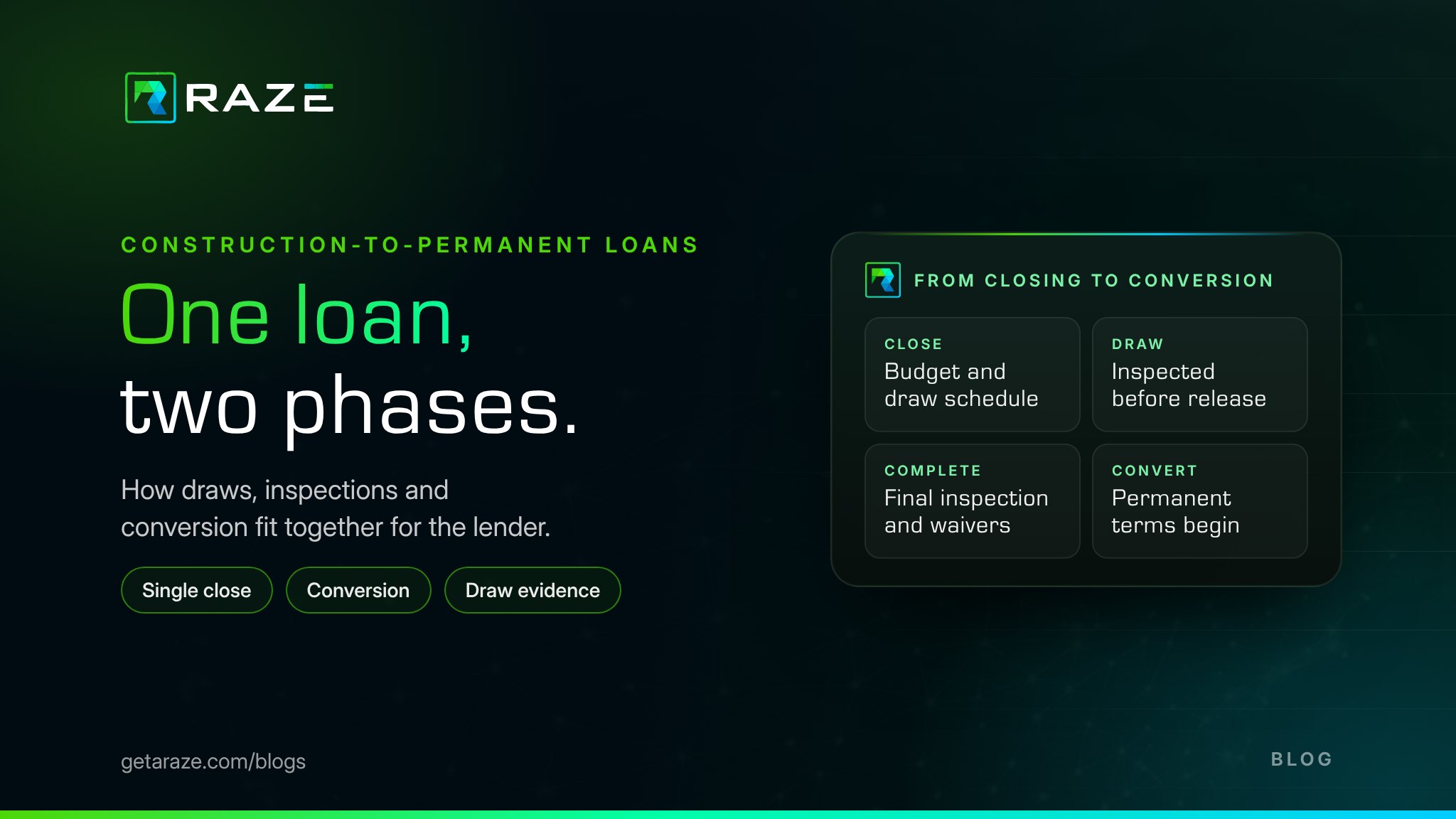
A construction-to-permanent loan closes once and then behaves like two loans. For the months of the build it works as a construction loan: funds go out in draws against inspected progress, and the borrower usually pays interest only on what has been drawn. When the house is finished, the loan converts to its permanent terms and starts to amortize.
From the lender's side, the hard part is the handoff. The permanent loan inherits whatever the draw phase recorded, so a weak draw file becomes a weak mortgage file. This guide covers how the two phases fit together, what each draw needs and what conversion asks for. For the short definition, see what a construction-to-permanent loan draw is. It is general information; the loan documents and your counsel set the rules for each program.
In a single-close loan, one closing covers both phases and the loan converts on completion. In a two-close loan, a construction loan is paid off by a separate permanent loan with its own closing. Regulation Z lets the creditor disclose a construction-permanent loan as one transaction or as separate transactions (12 CFR 1026.17(c)(6)(ii)).
That choice decides where draw costs are disclosed. When the phases are disclosed separately, the official commentary on that section (comment 17(c)(6)-5, Regulation Z interpretations) sets how fees are allocated between them: a charge imposed separately for one phase goes to that phase, and since the Bureau's 2017 revision, its "but for" test, which assigns to the construction phase the charges that would not exist without the construction financing, applies to finance charges and points and fees. Draw inspection fees arise only in the construction phase. The Bureau's interpretations of the Loan Estimate rules also treat inspection and handling fees for staged disbursements as loan costs; our post on construction loan draw fees covers how they are disclosed. Have compliance counsel confirm how each program allocates and discloses them.
| What changes | Construction phase | Permanent phase |
|---|---|---|
| How money moves | Construction phaseIn draws, released against inspected work on a draw schedule | Permanent phaseNo more draws; the converted balance amortizes |
| Interest | Construction phaseUsually charged only on the amount drawn so far | Permanent phasePrincipal and interest on the converted balance, per the note |
| Who documents progress | Construction phaseA draw inspector on each request, under the lender's policy | Permanent phaseNo further progress inspections |
| What closes it | Construction phaseA final inspection, final lien waivers, a title update and, where issued, a certificate of occupancy | Permanent phasePayoff, or the end of the term set in the note |
| The lender's main question | Construction phaseDoes the undisbursed balance still cover the work left? | Permanent phaseIs the finished house the collateral the loan was made against? |
The approved budget, by line or by stage, and the draw schedule set what each request can ask for.
The borrower or builder asks for a draw against specific lines, with invoices and any change orders.
The FDIC's construction and land development examination procedures ask whether inspections are made on an irregular schedule and before draw requests, by inspectors who are qualified and independent of the lending function.
A title update shows liens recorded since the last advance, and lien waivers show the people paid from it were paid. Our lien waiver guide covers the order.
The same FDIC procedures ask whether the undisbursed balance is enough to complete the project. Compare it with the work left after every draw.
The last advance waits for a final inspection, final waivers and, where the jurisdiction issues one, a certificate of occupancy. See the final draw checklist.
If early draws paid for more than was built, the money left may not finish the house, and the permanent loan cannot convert on an unfinished one. Compare each draw with its budget line, not only with the total.
Investor rules make the handoff concrete. Fannie Mae will not buy a single-closing construction-to-permanent loan until construction is complete and the loan has converted to its permanent terms, and at completion it requires an Appraisal Update and/or Completion Report (Form 1004D) completed in full, including the certification of completion (Selling Guide B5-3.1-02). Before delivery, all construction work that could support a mechanics' lien must be completed and paid for, and the lender keeps the completion report or an acceptable alternative in the loan file (B5-3.1-01).
The completion report comes from the appraiser, not the draw inspector. What the draw record adds is the path to it: how each budget line reached 100 percent, which advance paid for what, and who was paid. When a reviewer asks how a line got there, the answer is in the draw inspections, not in the final appraisal.
Percent complete on each draw sheet line at each visit, so the budget's path to completion can be traced advance by advance.
Photos with GPS coordinates and date and time stamps, linked to the lines they support, show where and when each stage was seen.
When each inspection was ordered, submitted and approved or rejected, and the reviewer's reason for any rejection.
A draw inspection reports the work in place. The completion report, the conversion and every release of funds stay with the lender and the parties its investor names.
RAZE documents the construction phase, draw by draw. The lender sets the required questions, photos and completion fields in the Ordering Engine, and the inspector completes them in the RAZE Mobile App. Each report shows percent complete for each draw sheet line, with photos linked to the lines they support, and every inspection keeps its status history, so the record that reaches conversion is the same one the lender reviewed at each draw.
Through RAZE, a residential draw inspection is a flat $125 per single-family inspection when RAZE sends the inspector, or $25 per request with your own inspector, at any U.S. address. See the RAZE Rate Card. RAZE documents the work; each release and the conversion stay with the lender.
What is a construction-to-permanent loan draw?
The short answer, with the Regulation Z citations.
Final draw on a construction loan: what to collect
The completion inspection, waivers and retainage.
Construction loan draw fees
The four charges on a draw and how they are disclosed.
What is a draw schedule?
Milestone and line-item schedules, side by side.
The same report for each advance, from the first draw to the one before conversion.
See a draw inspection on a project in your book, from order to delivered report.
Request a DemoCarry a clean draw record into every conversion.
Request a Demo