Custom Home Construction Draws vs. Production Builds
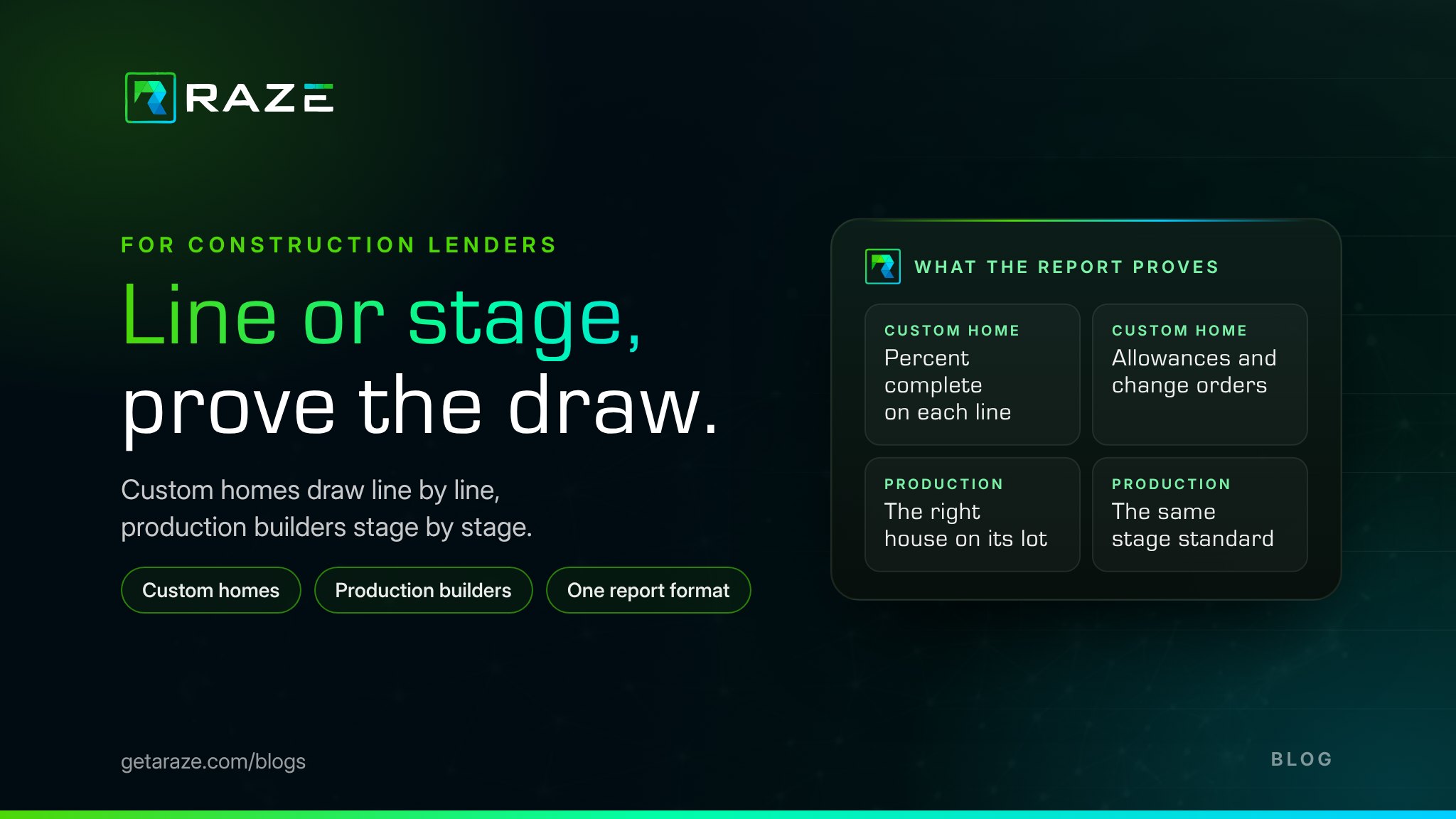
A custom home draw request arrives with a long list of budget lines, an allowance overrun on the kitchen and a change order the owners signed last week. The same morning, a production builder asks for draws on several houses that reached framing in one subdivision. Both are residential construction loan draws, and both need an inspection before funds go out, yet the evidence that supports each one is different.
This guide compares what each inspection has to prove and when to send someone. The loan agreement and the lender's policy decide how each loan funds.
Two ways a residential draw gets funded
The FDIC's examination manual describes two common ways construction funds go out. Under a standard payment plan, used mostly for homes and smaller commercial projects, fixed payments are released at the end of each construction stage. Under a progress payment plan, meant for larger and more complex projects, funds follow the work in place, usually month by month, with a share held back until completion.
Residential lenders use both, and many blend them. Custom homes often fund against a line-item budget, where the inspector reports percent complete on each line. Production builders often draw on a fixed stage schedule repeated across many houses. What a draw schedule is covers both shapes.
Custom homes vs. production builders
| What changes | Custom home | Production builder |
|---|---|---|
| Budget | Custom homeA line-item budget from the builder's cost breakdown, with allowances for the owners' selections | Production builderA repeated plan, with a set share released at each stage |
| Draw trigger | Custom homeThe builder asks when the work calls for it, so timing varies | Production builderA house reaches a stage, often with several houses at once |
| What the inspector measures | Custom homePercent complete on each budget line, against the approved scope and change orders | Production builderWhether each house has reached the stage the request names |
| Common exceptions | Custom homeUnapproved change orders and allowance overruns | Production builderThe wrong lot photographed or a stage called complete early |
| What the report must prove | Custom homeEach line's percentage matches the work in place, and the budget still covers completion | Production builderThe right house is at the right stage, on the same standard as every other house in the phase |
Custom homes: line items, allowances and change orders
A custom home is built once, to plans drawn for one owner, so its budget is usually a detailed cost breakdown rather than a stage table. Owners make selections as the build goes. Allowances set money aside for items such as cabinets and flooring before the owners choose them, and change orders add or move scope after closing.
That puts more weight on each line of the report. The inspector records percent complete against the approved scope, with approved change orders folded into the budget first and unapproved changes noted as exceptions (how change orders are handled). Special-order materials delivered before installation belong in their own entry; see stored materials in a construction draw.
The other question on every custom draw is balance: whether the undisbursed funds still cover the work left, since an allowance overrun on finishes can become a shortfall at the end. The FDIC's construction lending examination procedures ask whether the undisbursed balance is sufficient to complete the project and whether inspection reports are detailed enough to support disbursements.
Production builders: stages, many houses, one standard
A production builder repeats a small set of plans across a subdivision, so a fixed stage schedule fits: foundation, framing, dry-in, rough-ins, drywall, finishes and final, with a set share of each loan released at each stage. The stage-by-stage checklist covers what to verify at each one.
Each house is simpler to read, so the risk moves to identity and consistency. Houses on one street look alike at framing, and the report has to prove which lot it covers: the address or lot number, a photo that shows it, and capture data that places the photos there. Every inspector also has to call a stage the same way.
Lenders financing a phase track it as a whole, too. The FDIC's examination manual describes tract projects followed through progress reports on the entire project and a list of each lot with its release price, sales price and loan balance. An inspection that names each house by lot and stage feeds that list directly.
Policy stays with the lender.
Which schedule a loan uses, what each stage must show and how often it is inspected are set in the loan agreement and the lender's policy. A draw inspection documents the work in place; the funding decision belongs to the lender.
Cadence: when to send the inspector
Custom home draws are usually inspected on each request. The builder decides when to ask, so visits already fall at uneven intervals, and the pressure is speed: a slow report holds up subcontractor payments.
Production draws follow the stage calendar, often for several houses at once, so it pays to group inspections by subdivision and stage. A schedule that predictable has a weakness, though. The FDIC's examination procedures ask whether inspectors are rotated or independent of the lending function and whether inspections happen on an irregular schedule, so some lenders add an unannounced visit to a phase. How often construction loans are inspected covers the research on frequency.
Where RAZE fits
RAZE works from the lender's schedule, whichever shape it takes. The required questions, photos and completion fields for each line item or stage are configured in the Ordering Engine, and the RAZE Mobile App walks the inspector through them on site. Photos link to the draw sheet line items they support and carry GPS coordinates and date and time stamps, so a custom report shows the evidence behind each percentage and a production report places each house on its lot.
Your own inspectors can take an order through Direct Request, and RAZE Marketplace inspectors cover any U.S. address, with every report in the same format. Through RAZE, a residential draw inspection is a flat $125 per single-family inspection when RAZE sends the inspector, or $25 per request with your own inspector, whether the house is one of a kind or one of a phase. See the RAZE Rate Card. RAZE documents the work; the lender decides what each draw funds.
Frequently asked questions
Keep reading
What is a draw schedule?
Milestone and line-item schedules, side by side.
What is percent complete in a draw inspection?
How inspectors assess each budget line.
Draw inspection checklist for each build stage
What to verify at every stage of a residential build.
How many draws are in a construction loan?
What sets the count, and who decides it.
One report standard for every build
Every draw comes back with the same evidence, line by line or stage by stage.
Custom or production, every draw funds on evidence.The report has to prove the line or the stage.
One report standard for every kind of build.
Request a Demo