Loan officers
They need to know which loans need an inspection, how to order one and what to tell the borrower about site access.
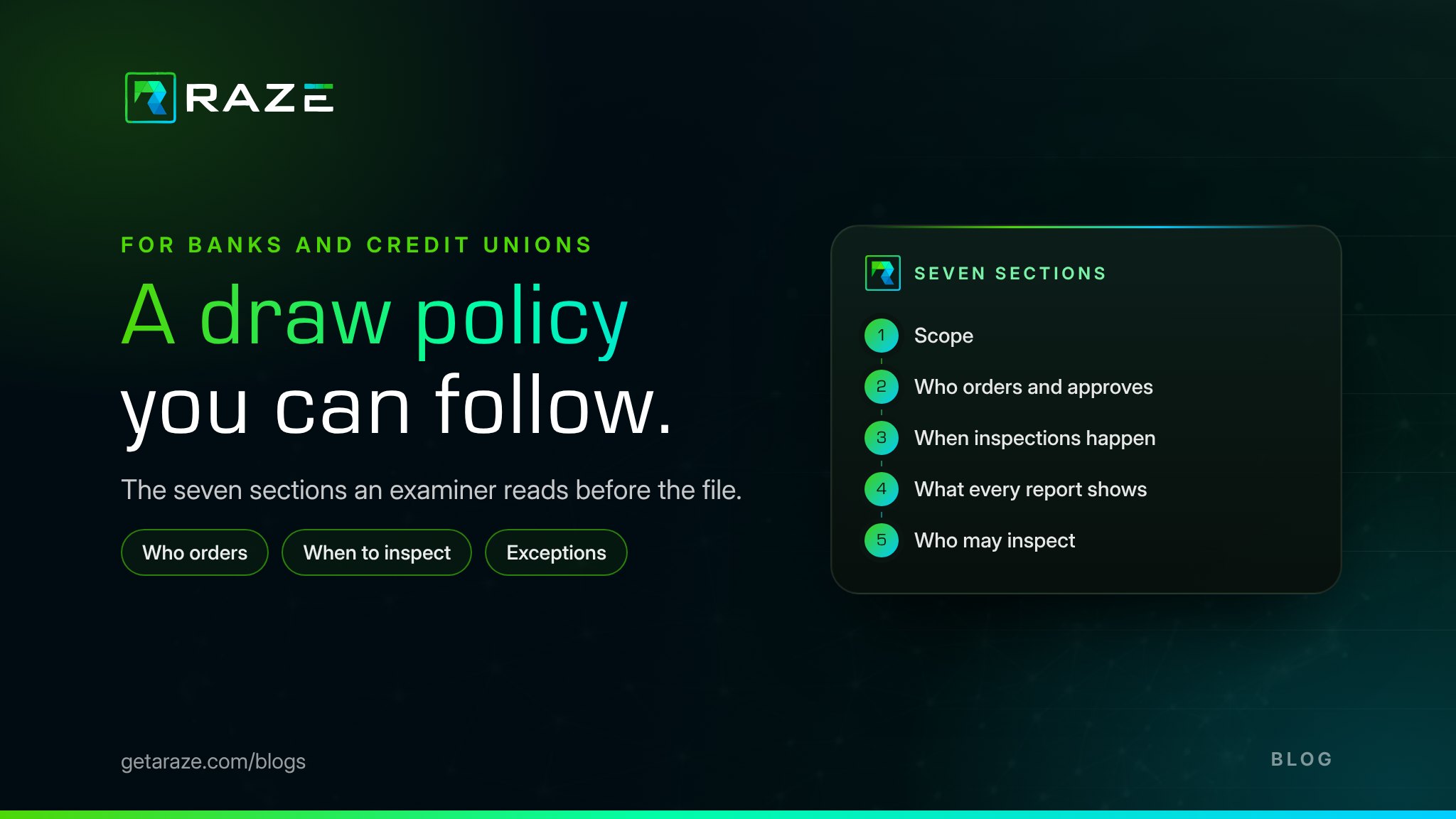
Every construction file is tested twice: once against the plans, and once against the lender's own policy. An examiner reads the policy first, then checks whether the file shows it was followed. A draw inspection policy that is vague, or that the team quietly works around, turns good loans into findings.
This guide walks through what supervisors expect a bank or credit union to write down and the seven sections most draw inspection policies need. How often to inspect is covered on its own in construction loan inspection frequency. Nothing here is legal advice; confirm the final policy with your compliance counsel.
For an FDIC-supervised bank, 12 CFR 365.2 requires written real estate lending policies, including loan administration procedures, reviewed and approved by the board at least annually. The Interagency Guidelines for Real Estate Lending Policies list loan closing and disbursement and collateral administration among those procedures, and say disbursements on a loan that funds several phases of a project should not exceed actual construction outlays. The OCC and the Federal Reserve publish the same guidelines for their banks.
The FDIC's construction and land development examination procedures then ask how inspections work in practice: whether inspectors are qualified, rotated or independent of the lending function; whether inspections happen on an irregular schedule and before draw requests; whether reports are detailed enough to support disbursements; and whether disbursements are made only after management reviews written inspection reports, lien searches and title updates. The OCC's Comptroller's Handbook describes reports that state compliance with plans and specifications, support percentage-complete disbursements and say whether the project is progressing as anticipated.
Credit unions work from the NCUA's examiner's guide, which says funds are released only after on-site inspections, documented in a written report by qualified personnel representing the credit union, that certify the requisitioned work is complete and that the remaining funds can finish the project. For commercial construction and development loans, 12 CFR 723.6 makes that a rule.
Name the loans the policy covers: residential construction, renovation, builder lines, owner-builder files. Say which ones need a site visit before every draw and which, if any, the lender reviews another way.
Separate the person who orders and reviews the inspection from the person who sold the loan where the team's size allows. The OCC's handbook lists segregation of duties, lien searches before disbursement, budget monitoring and dual approval of disbursements among effective controls.
Inspect before each draw, on a schedule the borrower cannot predict. Add visits between draws when a site looks stalled or a finished home sits unsold. See inspection frequency.
Each report shows percent complete for each budget line, photos tied to the lines they support, whether the work follows the plans, whether the project is on schedule and whether the remaining budget can finish it. See what a draw inspection report includes.
Set the qualifications, how an inspector or vendor is approved and how its work is spot-checked. For outside vendors, the interagency third-party guidance (June 2023) scales due diligence and ongoing monitoring to the risk of the activity.
Say who may approve a draw without a fresh inspection, how the reason is recorded, and what happens when a report does not support the amount requested. See unsupported draws.
List what the file keeps for each draw: the request, the report and photos, the lien search or title update and the approval. Set retention with counsel; see the compliance FAQ.
Write the steps your team can follow on every draw. A rule that is skipped in practice, with no recorded exception, is harder to defend than a simpler rule that is followed.
They need to know which loans need an inspection, how to order one and what to tell the borrower about site access.
They need to know what a complete report looks like, what blocks funding and how an exception is approved and recorded.
They need the photos, questions and line items every visit must cover, written as requirements rather than preferences.
A policy is easier to follow when it travels with the order. In the Ordering Engine, the lender sets the required questions and photos for its inspections, so the items the policy names go out with every assignment and the inspector completes them in the RAZE Mobile App. The lender can send the order to its own inspector or vendor through Direct Request, or have RAZE send one through Marketplace, and both come back in the same report format. Photos carry GPS coordinates and date and time stamps and link to the draw sheet line items they support. Each inspection keeps its status history, and a rejected report goes back to the inspector with the reviewer's reason. Between draws, the project's Workflow tab can schedule recurring inspections.
Through RAZE, a draw inspection is a flat $125 per single-family inspection when RAZE sends the inspector, or $25 per request with your own inspector, at any U.S. address. See the RAZE Rate Card. The record is built to support audit and exam review; the policy, the exceptions and every funding decision stay with the lender.
Construction loan inspection frequency
What the FDIC researchers found about inspection timing.
How examiners review monitoring
What an exam looks for in a construction file.
Draw inspection checklist
What to confirm at each build stage.
Best draw inspector for banks
The checklist a bank uses to choose a provider.
The same required photos and questions for every inspection, whoever sends the inspector.
See a draw inspection on a project in your book, from order to delivered report.
Request a DemoPut your draw inspection policy into every order.
Request a Demo