Work in place
The rule does not change with the season. A draw pays for work the inspection shows installed, so a weather stop changes how much work there is, not how it is measured.
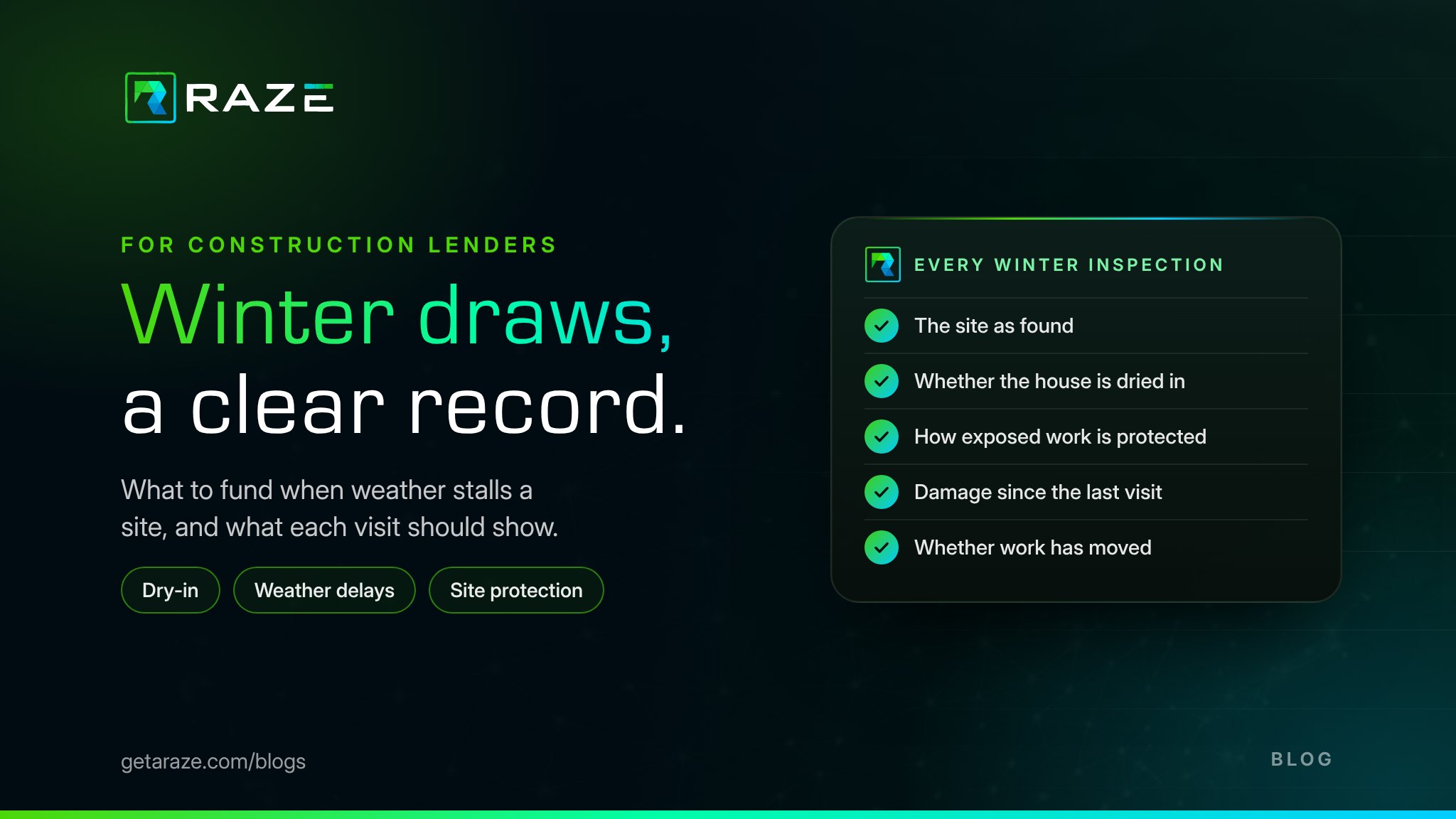
Across much of the country, late fall is when builders race to close houses in before the cold, and winter is when some sites slow or stop. That is a planning assumption, not a statistic, but it changes what a lender sees in the draws that arrive between now and spring.
This guide covers why dry-in timing matters before the cold months, what to fund when weather stalls a site, and what each inspection should record while it does. The loan agreement and the lender's policy decide what funds; the inspection documents what is on site.
A house is dried in when the roof is on and the windows and exterior doors are installed, so rain and snow stay out. Before that point, framing, sheathing and anything stored inside are exposed. After it, interior trades can keep working with temporary heat, and materials can be kept under cover. Many draw schedules pay a draw at that milestone; see what a draw schedule is.
Concrete is the other cold-weather item. The American Concrete Institute's Guide to Cold Weather Concreting (ACI 306R-16) treats cold weather as air temperatures that have fallen, or are expected to fall, below 40°F while the concrete needs protection. Blankets, enclosures and heaters around a fresh pour are part of the work, and a report that shows them tells the lender the builder planned for the season.
The rule does not change with the season. A draw pays for work the inspection shows installed, so a weather stop changes how much work there is, not how it is measured.
Lumber, windows or cabinets delivered early to beat the weather are funded only as the lender's policy allows, and only when they are on site, covered and secured.
Tarps, temporary heat and snow removal usually belong to general conditions or contingency. The OCC says general conditions are funded with each advance as costs arise, not up front.
For the stored-materials rules, see what stored materials are in a construction draw and how they are verified. The OCC's Comptroller's Handbook is the source for the general-conditions point, and the Interagency Guidelines say disbursements on a multi-phase loan should not exceed actual construction outlays, in winter as in summer.
The report states snow cover, frozen or muddy ground and anything that limited access, so a lighter report is not read as a missed visit.
Photos show the roof, windows and exterior doors, because the milestone decides how exposed the rest of the work is.
Look for covered framing, blankets on fresh concrete, temporary heat inside and materials kept off the ground and under cover.
The report notes water inside, wind or snow damage and frozen pipes. The inspector documents what is visible; questions about cause and insurance go to the builder and the insurer.
The same stage on two visits in a row is the signal. Dated photos against the previous report make the comparison simple.
The OCC's handbook notes interest reserves are often used up before completion, often because of construction delays, and that a reserve handled poorly can mask a project that is not performing.
Ask each builder in the fall when the house will be dried in and what the plan is if it is not. Compare the answer with the construction period in the loan agreement and the interest reserve left. A delay found in November is a scheduling question; the same delay found the week the construction period ends is a credit question. Extensions, reserve changes and every release of funds stay with the lender. For houses built without a buyer, see spotting a stalled spec home.
The lender sets the required questions and photos for its inspections in the Ordering Engine, so winter items such as "Is the house dried in?" or "Is exposed work protected?" go out with every order. Inspectors capture them in the RAZE Mobile App, which keeps working with no signal on a remote site and syncs in full once the device reconnects. Photos carry GPS coordinates and date and time stamps and link to the draw sheet line items they support, so the report shows the site on the day of the visit. When a site goes quiet between draws, an inspection can be ordered through the same workflow.
Through RAZE, a draw inspection is a flat $125 per single-family inspection when RAZE sends the inspector, or $25 per request with your own inspector, at any U.S. address. See the RAZE Rate Card. RAZE documents the site; the lender decides what to fund.
Draw inspection checklist
What to confirm at each build stage.
Stored materials in a draw
When delivered materials can be funded.
Draw inspection turnaround time
Which delays the lender controls and which it does not.
Construction loan inspection frequency
What the FDIC researchers found about inspection timing.
Dated, located photos for every draw, through the winter and into spring.
See a draw inspection on a project in your book, from order to delivered report.
Request a DemoSee every site as it stands, whatever the weather.
Request a Demo