Draw Inspection Turnaround Time: What Drives Delays
A borrower calls on day four asking where the money is, and nobody can say which step is holding the draw. Draw inspection turnaround time is the part of that wait most lenders measure least, because the clock starts in one system and stops in another.
Here, turnaround means the time from the lender's order to a submitted report. The site visit itself is short: a residential draw inspection usually takes about 15 to 45 minutes on site. The rest is ordering, assignment, scheduling, access, travel, capture and review. For the short answer, see how long a draw inspection takes.
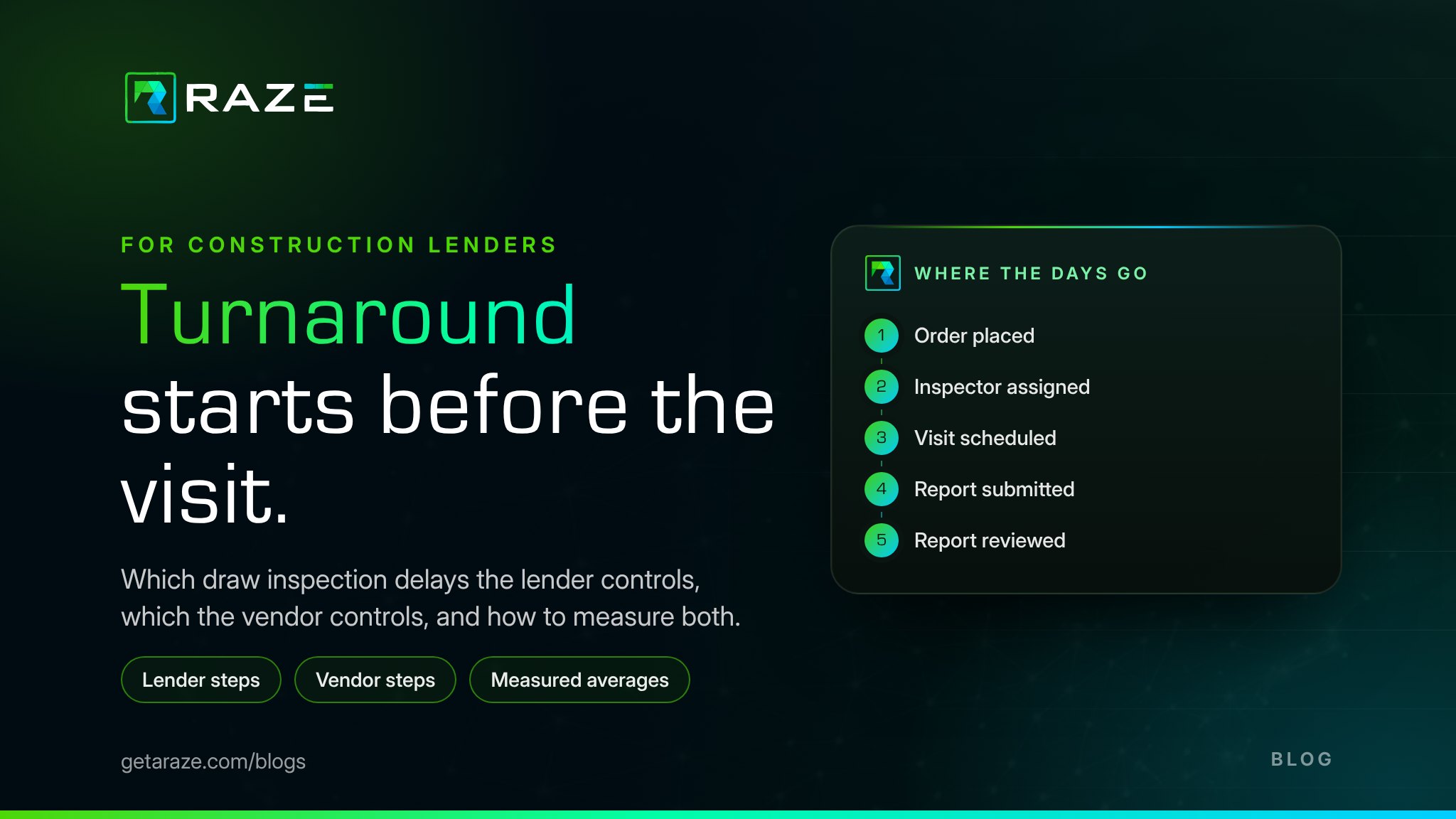
Where the days go
| Step | Who controls it | What slows it |
|---|---|---|
| Order placed | Who controls itLender | What slows itAn incomplete draw request, re-keying into a vendor portal, or an order sent by email and missed |
| Inspector assigned | Who controls itVendor | What slows itNo inspector near the address, manual dispatch, or assignments offered to one inspector at a time |
| Visit scheduled | Who controls itBorrower, builder and vendor | What slows itAn unknown or unreachable site contact, a locked site or a missing lockbox code |
| On site | Who controls itInspector | What slows itWeather, a missing budget or plans, or work areas the inspector cannot reach |
| Report submitted | Who controls itVendor | What slows itReports assembled by hand, photos sorted after the visit, or a quality review queue |
| Report reviewed | Who controls itLender | What slows itA report sitting in one person's inbox, or questions sent back by email |
Half of those steps sit at least partly with the lender or the borrower. A vendor can be quick on every step it controls and the draw can still wait, which is why a turnaround number means little until you know where its clock starts and stops.
Delays the lender controls
- A complete order. Send the draw request, budget and site contact with the order, so the inspector does not wait on a second email.
- One place to order. Re-keying an order into a portal, or emailing a vendor, adds hours before anyone is assigned. Ordering from the system where the request lands removes that step.
- Site access. Ask the borrower for the site contact and access instructions when the draw is requested, not when the inspector calls.
- Review. A submitted report that sits in one inbox is a delay the vendor never sees. Route reports to a shared queue and watch its age. Dead days shows how to put a cost on the wait.
Delays the vendor controls
Assignment, travel, capture and report assembly belong to the vendor. Ask any vendor four things: how inspectors are assigned and how far they travel; whether capture happens in an app that builds the report or in a camera roll sorted later; whether you can see status from order to submission; and how its turnaround figure is measured. See how to choose a draw inspection company.
How to read a turnaround number
A useful turnaround figure is an average with its method stated: which orders it covers, and from which event to which. A promise for every order ignores access, weather and location, which move individual inspections no matter who the vendor is.
Measure your own process too. Record when each draw request arrives, when the order is placed, when the report is submitted and when the draw is funded. The gaps show which step to fix first.
RAZE turnaround, with its method
Under RAZE's standard agreement, reports are submitted within three business days. RAZE averages 1.1 days from request to submission on residential draw inspections nationwide, an average rather than a promise for any one order.
Orders start in the Ordering Engine, in your own system through the RAZE API, or in an AI assistant through the RAZE MCP. Marketplace assigns an available inspector from the RAZE Inspection Network by location and availability, the assignment reaches the inspector's RAZE Mobile App with your requirements attached, and every status change is visible from order to submission. Through RAZE it is a flat $125 per single-family inspection when RAZE sends the inspector, or $25 per request with your own inspector. See the RAZE Rate Card.
Frequently asked questions
Keep reading
How long does a draw inspection take?
Time on site, and the full turnaround around it.
How long does it take to fund a construction draw?
Where the inspection fits in the funding timeline.
Dead days: the interest hiding in your draw cycle
What a waiting draw costs, and where to find it.
How to choose a draw inspection company
What to check before the first order.
See where your draw inspections wait
Every status change is visible from order to submission, whether you order from your screen, your system or your AI assistant.
For Lenders
See the status of a draw inspection on a project in your book, from order to delivered report.
Request a DemoThe Rate Card
Residential draw inspection pricing for any U.S. address, with the commercial terms.
See the rate cardMeasure the clock first.Then fix the step that holds it.
See where your draws wait.
Request a Demo