Staff in the footprint
A construction specialist or trained loan staff inspect near the branches. It works where the drive is short and stretches thin when a member builds two counties away.
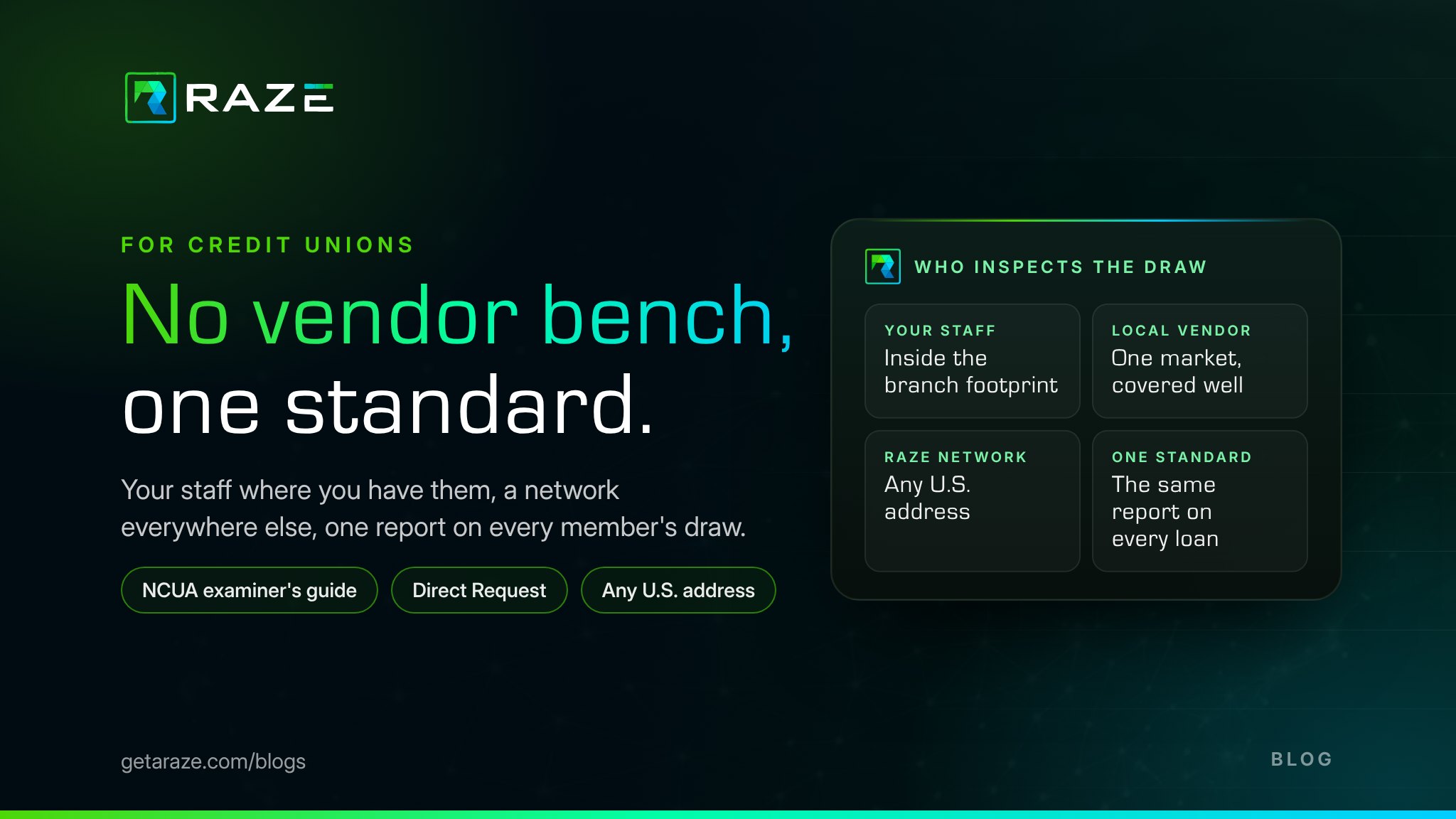
Construction lending teams at credit unions are often small, and not every team keeps a bench of draw inspectors in each county where members build. The control still has to hold: a written report before each advance, made by someone qualified and read by someone who can tell whether the work supports the request.
This guide covers what the NCUA expects before an advance, the three ways a credit union without a panel staffs its inspections and how to run them as one workflow. What to require of the inspector you pick is covered in the best draw inspector for credit unions. Nothing here is legal advice; confirm your policy with compliance counsel.
The construction and development section of the NCUA's examiner's guide says funds are released only after on-site inspections, documented in a written report by qualified personnel representing the credit union, that certify the requisitioned work is complete and that the remaining funds can finish the project. It says the people who qualify are often building inspectors, commercial contractors, architects or civil engineers.
The same guide lets a credit union supplement its staff with third-party experts, as long as staff can understand the third party's work, oversee its performance and confirm it follows the credit union's policies. That is the opening for a team without its own inspectors: the inspection can come from outside, while the oversight stays in the building.
12 CFR 723.6 writes these controls into the rule for commercial construction and development loans, and 12 CFR 723.2 leaves loans secured by a one- to four-family residential property out of the commercial loan definition. A member's home construction loan follows the credit union's own policy, so confirm the scope with compliance counsel.
A construction specialist or trained loan staff inspect near the branches. It works where the drive is short and stretches thin when a member builds two counties away.
An independent inspector or firm covers one market well. Each new county means another vendor to vet, another invoice and another report format.
A managed network sends an inspector to any address, so coverage no longer depends on a bench. The credit union still owns the oversight and the funding decision.
A lean team can use all three at once. The trouble starts when each one produces its own report, so a reviewer reads a staff checklist on one loan and a vendor PDF on the next, and the file an examiner opens looks different for every member.
Required photos, observations and questions belong to the credit union's draw inspection policy, not to whoever drives out to the site.
Send orders inside the footprint to your own inspectors and orders outside it to the network, under the same template. When to use which is covered in Marketplace vs. Direct Request.
Put every order, status and report in one place, so a two-person team sees what is waiting without calling anyone.
The NCUA's letter 07-CU-13 frames third-party oversight as risk assessment and planning, due diligence, and ongoing monitoring and control. Keep that record for every outside inspector or firm.
Reviewers compare percent complete and photos with the budget lines the advance pays for. When the work does not support the amount, the credit union weighs its options and decides what funds.
A draw inspection reports what is on site. Approving the advance, holding it or asking for more stays with the credit union's reviewers.
RAZE runs all three on one report standard. Direct Request sends an order to the credit union's own inspector (staff or a vendor it already uses), and Marketplace sends a background-checked inspector from the RAZE Inspection Network to any U.S. address. Orders, status and reports sit in the Ordering Engine; the credit union sets the required questions and photos, and the inspector completes them in the RAZE Mobile App. Photos carry GPS coordinates and date and time stamps and link to the draw sheet line items they support, and every status change stays on the record.
Through RAZE, every member's build is priced the same: a flat $125 per single-family inspection when RAZE sends the inspector, or $25 per request with your own inspector, at any U.S. address. See the RAZE Rate Card. RAZE sits beside the core, LOS and servicing systems a credit union already runs, and orders come from the Ordering Engine, the RAZE API or the RAZE MCP. See draw inspections for credit unions and the draw inspection solution.
Your inspectors where you have them and the RAZE Inspection Network everywhere else, on the same report.
See a draw inspection on a project in your book, from order to delivered report.
Request a DemoOne report standard for every member's build.
Request a Demo