Draw Inspection Report Standard: What to Require
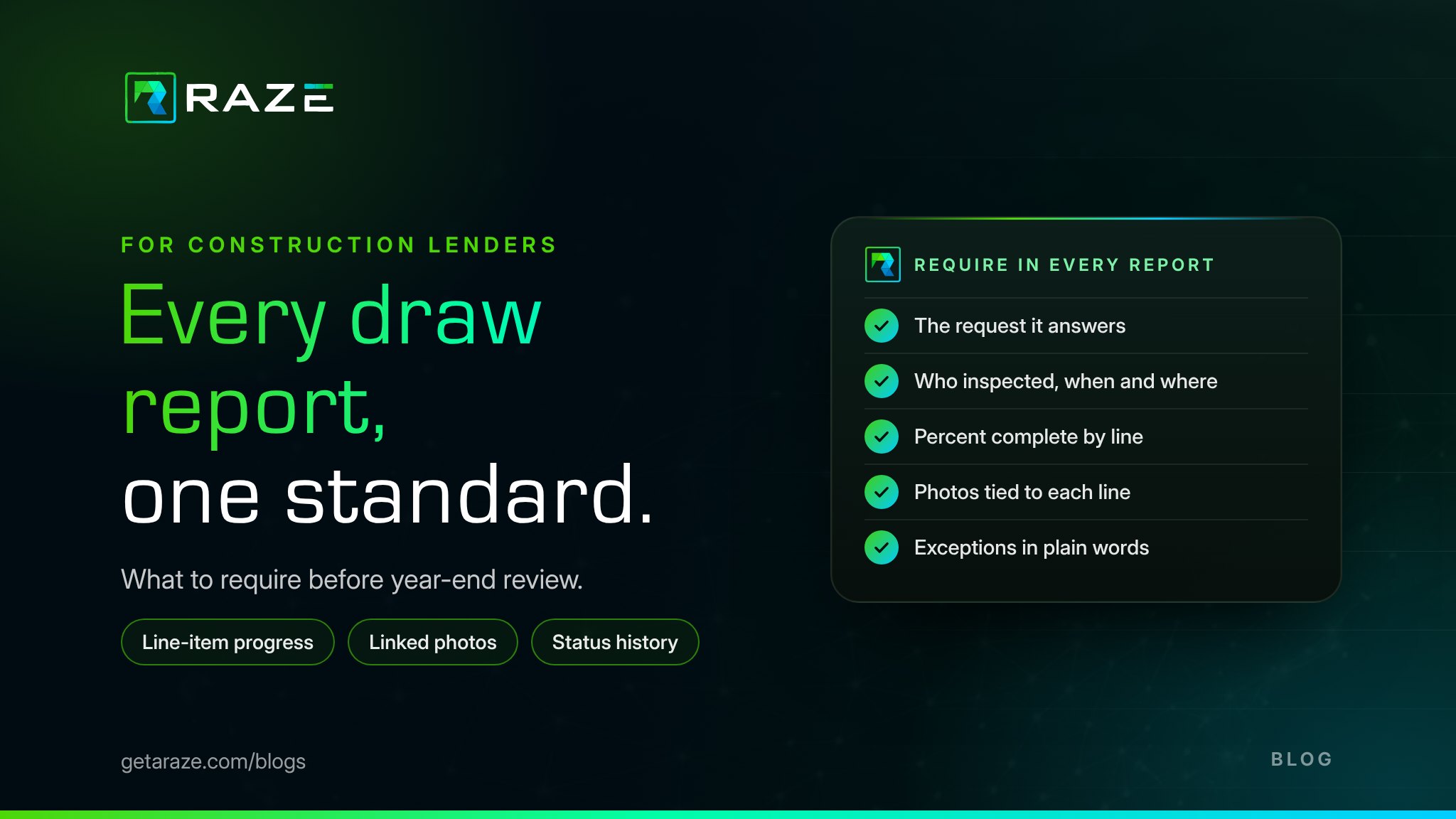
Year-end is when a construction file gets read by someone who was not there: internal audit, loan review, a participant bank or an examiner. At each draw, the inspection report is often the only independent record of what the lender's money bought. If one inspector writes three lines and another sends forty photos with no captions, the file answers different questions on different loans.
A report standard fixes that. It is the short list your policy points to, and every report has to meet it, whoever did the inspection. This guide sets out what the standard should require and how to check a year's files against it. For the plain list of what a typical report includes, see What is included in a draw inspection report?
What reviewers ask of a report
The regulators describe the report by what it has to support. The FDIC's construction and land development examination procedures ask whether reports are detailed enough to support disbursements, and whether disbursements are made only after management reviews written inspection reports, lien searches and title updates. The OCC's Comptroller's Handbook describes reports that state compliance with plans and specifications, support percentage-complete disbursements and say whether the project is progressing as anticipated.
For credit unions, the NCUA's examiner's guide says funds are released only after on-site inspections, documented in a written report by qualified personnel representing the credit union, that certify the requisitioned work is complete and that the remaining funds can finish the project. None of the three prescribes a form. Each asks whether the report in the file supports the money that went out.
Nine things the standard should require
The request it answers
The draw number, the amount requested and the budget lines in the request, so a reviewer can read the report against the draw request line by line.
The lender's criteria, answered
The questions and photos your policy requires, set before the visit and answered on every report. A required answer the inspector can skip is not required.
Who inspected
The inspector or vendor by name, so the file shows the work was done by someone your policy qualifies and who is independent of the borrower and the builder.
When and where
The inspection date, and photos that carry their own date, time and location, so the record shows the visit happened at that address before the draw was funded.
Percent complete by budget line
Each line's percent complete against the approved budget, with the prior inspection beside it, so the change this draw pays for is visible.
Photos tied to the lines they support
Photos numbered or linked to the draw sheet, so a funded line points to the picture behind it. See photo requirements.
Stored materials
What is on site and not yet installed, where it is kept and whether it is protected, so a later report can confirm it was installed.
Exceptions in plain words
Work billed ahead of progress, changes the lender has not approved, stalled activity or a site concern, written where the reviewer cannot miss it.
A history of the record
Status changes, who made them and the reviewer's acceptance or rejection with its reason, so the file shows what happened after submission too.
What a report should not try to do
- Approve the draw
- Set the amount to fund
- Certify code compliance
- Appraise the property
- Replace an engineering review
- Replace the lender's own review
A draw inspection report is evidence of work in place. The lender reads it beside the budget, invoices, lien waivers and its own policy, and the lender decides. A standard that asks the inspector to make the funding call blurs who is accountable for it.
Run a year-end file check
Before audit or exam season, pull a sample of funded draws from each construction product and read them the way an outsider would. Your policy or internal audit sets the sample size. For each draw, ask:
- Is there a written report dated before the funds went out?
- Can every funded line be matched to a percentage and a photo?
- Were the exceptions the report raised resolved, and is the resolution in the file?
- Do reports from different inspectors answer the same questions in the same order?
- Where a draw was funded without a fresh inspection, is the reason recorded under the exceptions section of your draw inspection policy?
Gaps found in November can still be fixed in the standard for next year. Gaps an examiner finds become findings.
Built to support audit and exam review.
A consistent report does not make a file compliant. It makes the file readable, so the people who review it can see what the lender saw when it funded.
Where RAZE fits
In RAZE, the lender sets the required questions and photos in the Ordering Engine, so its criteria travel with every order. The inspector completes them in the RAZE Mobile App, where photos carry GPS coordinates and date and time stamps and link to the draw sheet line items they support. Each inspection keeps a history of its status changes and who made them. The lender's reviewer accepts or rejects each submitted inspection, unless the institution has turned on auto-approve, a workflow setting rather than an AI decision; a rejection carries the reviewer's reason back to the inspector.
RAZE builds your standard report once with your logo, brand colors, cover fields, on-site questions and one of three draw sheet styles: line-item, percent-based stages or a custom budget in dollars. Every inspection after that comes back as a PDF in the same format, in the Ordering Engine and by API, whether a RAZE Marketplace inspector or your own inspector did the work. Page through the example report or see how RAZE runs draw inspections.
Frequently asked questions
Keep reading
What is in a draw inspection report?
The short list of what a typical report includes.
How to write a draw inspection policy
The policy this report standard belongs to.
What is percent complete?
How inspectors measure progress by budget line.
Construction draw red flags
The exceptions worth a line in the report.
One report standard for every draw
Set your criteria once and get every report back in your format.
For Lenders
See a draw inspection on a project in your book, from order to delivered report.
Request a DemoDraw Inspections
Your inspector or ours, one report format, at any U.S. address.
See RAZE Draw InspectionsWrite the standard once,and every report meets it.
Get every draw report in one standard.
Request a Demo