Soft Cost Draws: What an Inspection Cannot Verify
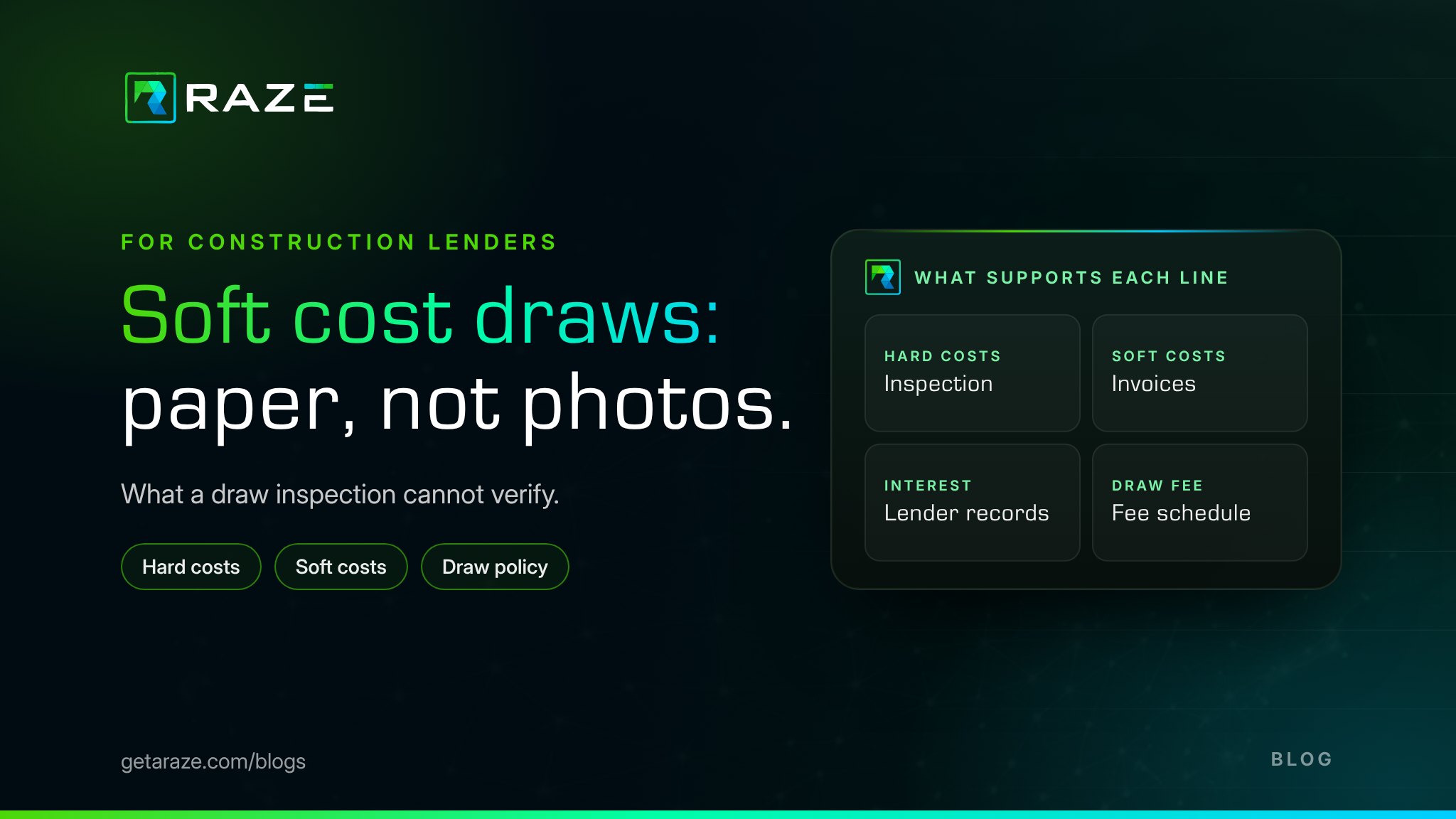
A draw request arrives with five lines. Three are framing, roofing and windows. The other two are an engineer's invoice and a permit fee. An inspector can stand in front of the first three. Nobody can photograph the other two.
The short question has its own page: are soft costs paid through construction draws. This guide covers what a draw inspection can and cannot support, and the rule a lender writes for the lines that need paper. Each lender sets its own policy; nothing here replaces it.
Hard costs and soft costs
Hard costs are the direct construction costs that physically build the project: labor, materials, equipment and site work. Soft costs are the non-construction project costs, such as architecture, engineering, permits, legal fees, insurance and financing charges.
A draw inspection documents work in place. That makes it evidence for hard costs and not for soft ones. The table shows what supports each kind of line.
| The line | What it pays for | What supports it |
|---|---|---|
| Hard costs | What it pays forLabor, materials, equipment and site work | What supports itThe inspection report: percent complete and photos of the work |
| Soft costs | What it pays forArchitecture, engineering, permits, legal fees and insurance | What supports itThe invoices and documents the lender's policy names |
| Interest reserve | What it pays forLoan funds set aside at closing to cover interest during construction | What supports itThe lender's records of interest charged |
| Draw fee | What it pays forThe lender's charge for processing each draw request | What supports itThe lender's fee schedule |
The interest reserve and the draw fee each have a page of their own.
Write the soft cost rule
Separate the two in the budget
Keep soft cost lines apart from hard cost lines on the budget, so a reviewer knows which lines the inspection speaks to and which it does not.
Name the support for each soft line
Say what the file needs before a soft cost is paid: the invoice, who it is from and what it covers. The inspector is not the source for any of it.
Say who reviews it
Soft costs are reviewed at the desk. Name the role that checks the paper, so a soft line is not waved through because the inspection on the same draw looked clean.
Keep soft costs in the cost to finish
Cost-to-complete starts from the approved budget. Soft lines that are in the budget and not yet paid are part of it.
Which soft costs a loan funds is the loan agreement's answer.
Which soft costs go through draws is set by the loan documents and the lender's policy. This guide does not list what a loan must fund.
Where RAZE fits
RAZE covers the lines an inspector can see. The lender sets the required questions and photos on each order in the Ordering Engine, and the report comes back by line item, with each photo carrying GPS coordinates and date and time stamps and linked to the draw sheet line it supports. Each line shows the prior inspection's percent beside the current one.
RAZE does not verify invoices or soft costs, and it does not approve, deny or fund draws. The lender reviews the paper for the soft lines and decides what to fund.
Frequently asked questions
Keep reading
Are soft costs paid through construction draws?
The short answer, on one page.
Construction loan draw fees
What a lender charges per draw, and why.
Construction draw disbursement methods
Who receives the money once a draw is approved.
How to write a draw inspection policy
The policy this rule belongs in.
Evidence for the lines you can see
See progress by line item, with photos tied to each line.
For Lenders
See a draw inspection on a project in your book, from order to delivered report.
Get StartedPhotos for the work in place.Paper for everything else.
Evidence for the lines an inspector can see.
Get Started