Builder Line of Credit Draws: Many Homes, One Line
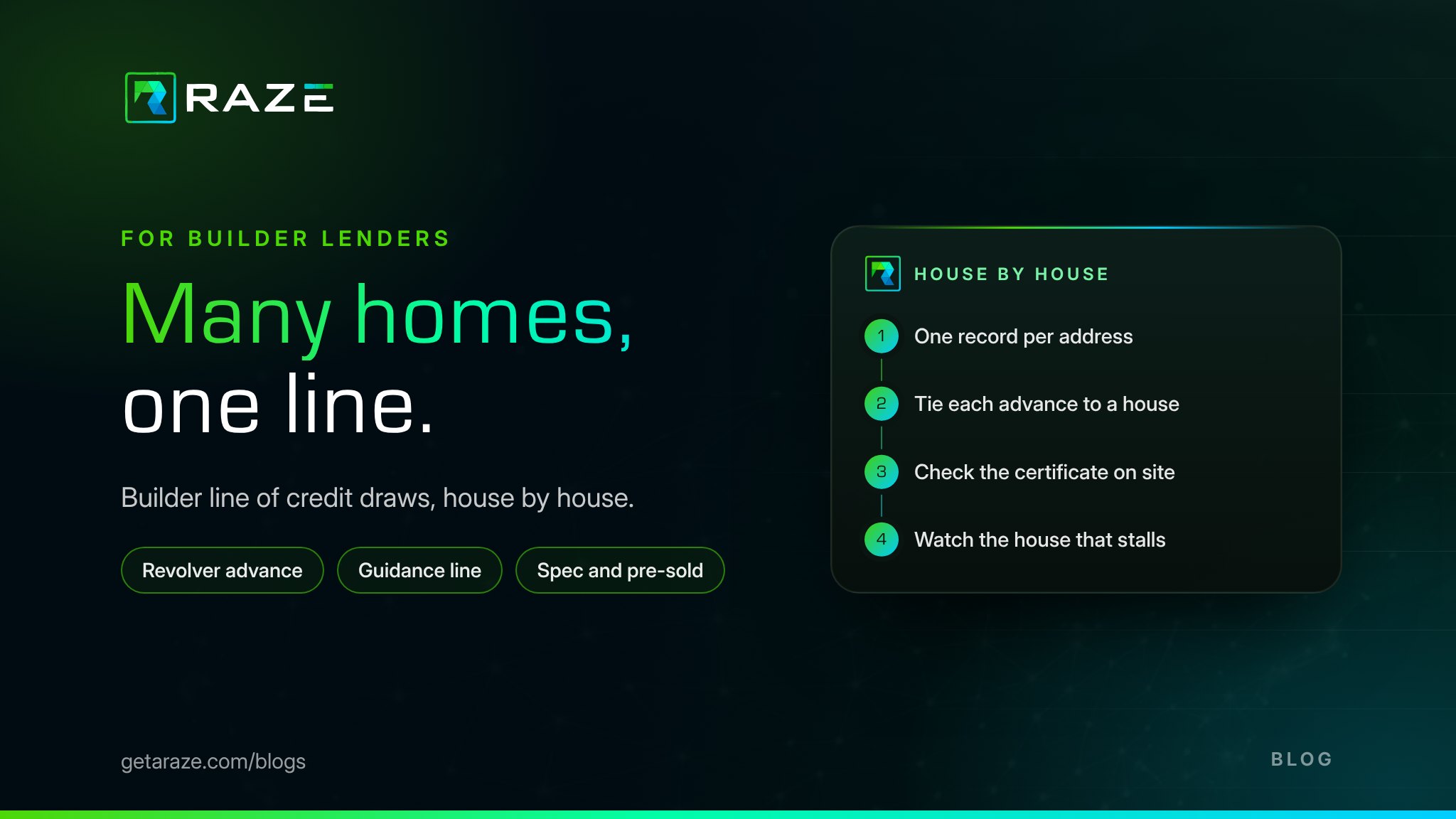
One builder has several houses on one credit facility. The draw request that arrives on Monday covers more than one address, each at a different stage. The total looks reasonable. The question is whether each house supports its share.
The definition has its own page: what a builder line of credit is. This guide covers how draws on a line are inspected and filed, house by house. How a lender sizes or prices a line is its own decision and is not covered here.
The line and the houses on it
A revolver advance is a draw against a revolving builder credit facility. It is repaid as homes sell and made available again for new starts. A guidance line is an uncommitted credit facility where the lender reviews and approves each project individually before advancing funds.
On a builder's line the collateral is a set of separate houses, and they are not all the same kind. The spec home inspection policy covers each kind in full.
| The house | What it is | What the inspection adds |
|---|---|---|
| Presold | What it isA home with an executed purchase contract in place before or during construction | What the inspection addsThe stage and date on record |
| Spec | What it isA home built on speculation, without a committed end buyer | What the inspection addsWhether the house is still moving |
| Finished and unsold | What it isA completed home that has not sold | What the inspection addsIts condition while it waits |
Run the line house by house
Give each address its own record
Each house is its own collateral. Keep one budget, one draw history and one inspection history for each address, so a draw across four houses can be read as four draws.
Tie each advance to a house and a stage
Before funding, the reviewer should be able to say which house each dollar is for and what work in place supports it. The percent complete guide covers how to read a line.
Check the certificate against the ground
The OCC's Comptroller's Handbook, cited in the builder line answer, says availability is usually set by a borrower-prepared borrowing base certificate. An inspection history by address, stage and date is what lets a lender check it against the ground.
Watch the house that stops moving
A line can look healthy in total while one house has stalled. The spec home inspection policy covers unsold homes, and the stalled loan guide covers what to record when work stops.
The line's limits stay with the lender.
The borrowing base, the limit on unsold homes and every advance are the lender's decisions under its loan agreement. An inspection documents each house. It does not size the line.
Where RAZE fits
In RAZE each house is its own project with its own address. The lender orders and tracks every inspection across the builder's line from the Ordering Engine, with its own required questions and photos on each order. Photos carry GPS coordinates and date and time stamps and link to the draw sheet line items they support.
RAZE documents each house; the borrowing base, the spec limits and every advance stay with the lender.
Frequently asked questions
Keep reading
Every house on the line, on record
See progress by address, with photos tied to each draw sheet line.
For Lenders
See a draw inspection on a project in your book, from order to delivered report.
Get StartedThe line is one loan.Keep one record for each house.
Track every house on the line by address.
Get Started