At the stop
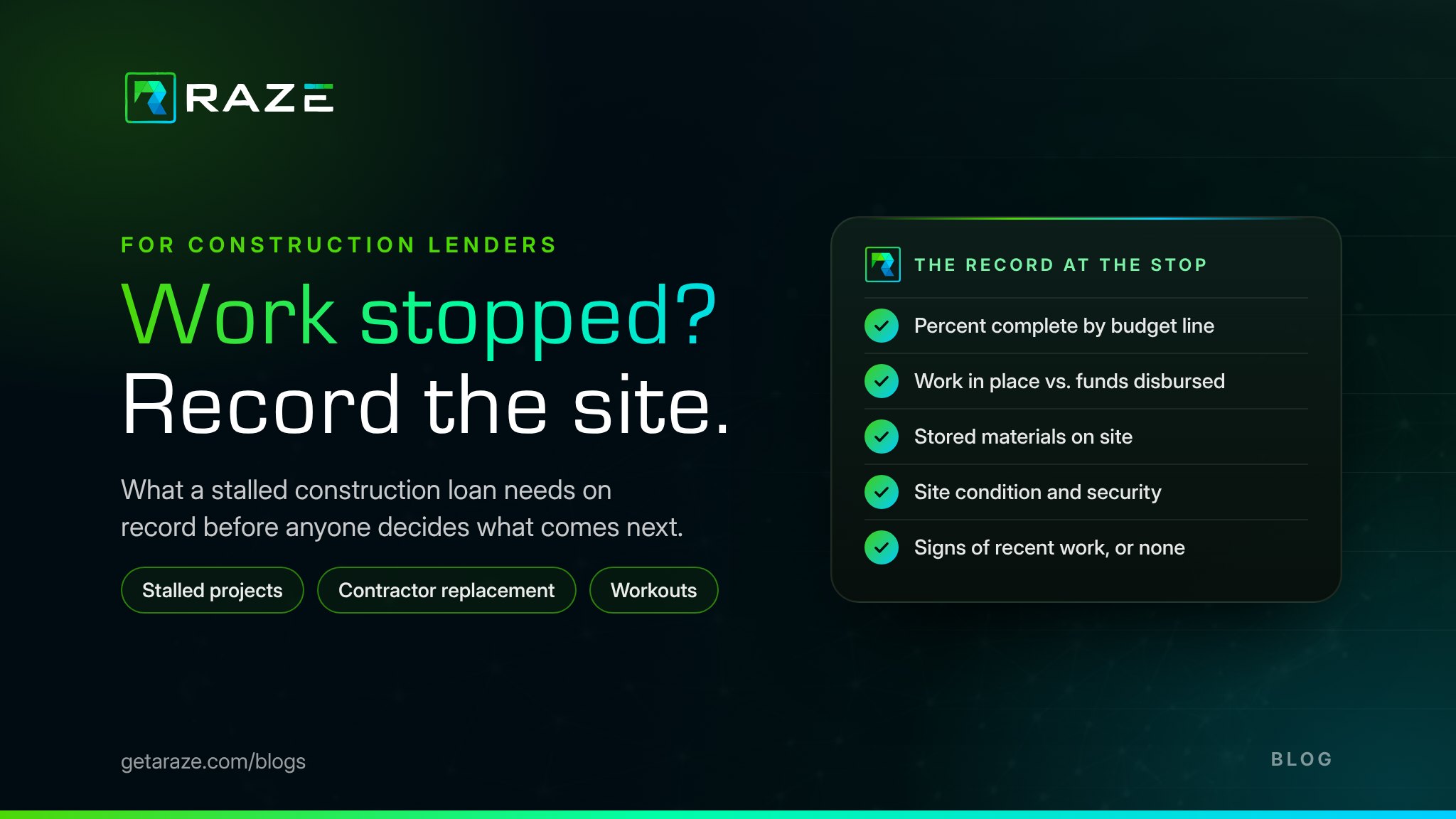
Document the site before anyone else works on it: percent complete, stored materials, condition and security.
A stalled construction loan rarely announces itself. The draw requests slow down or stop, the builder stops returning calls, or the last inspection shows the same stage as the one before. By then the question on the lender's desk has changed. It is no longer what this draw pays for; it is what is on site, what is left to build and what it will cost to finish.
This guide covers what an inspection should document when work stops and what a replacement contractor and a workout team need from that record. The loan agreement, the lender's policy and its counsel decide what happens to the loan.
Most stalls are visible in the file before anyone calls them a stall:
A borrower who stops asking for money is not necessarily on track, which is why many lenders schedule progress inspections between draws. See construction draw red flags for earlier signals and the October market note for the backdrop.
The FDIC's 2008 primer on interest reserves warns that a project not completed on time may appear to perform while the reserve keeps the troubled loan current.
Every decision about a stalled loan starts from one fact: how much of the house exists. The FDIC's examination manual names the need to complete projects within cost and time limits as the major risk in construction lending, and says that if a loan defaults, the institution must be in a position to either complete the project or salvage its construction advances.
The FDIC's construction and land development examination procedures ask whether the undisbursed balance is sufficient to complete the project, and whether extensions or increases in interest reserves are supported by a reasonable and realistic assessment of the project's continued feasibility and the timeframe for completion. The FDIC's Supervisory Insights primer on interest reserves (Summer 2008) adds that reserves may not suit projects with construction delays or cost overruns. The last draw request answers none of this; a current, dated record of the site, read against the budget, does. That record is how a cost-to-complete figure is built.
Measure each line against the approved budget, not against the last draw request. See percent complete for how inspectors report it.
The gap between what has been paid and what is installed is the number the lender needs most.
Record what is on site, whether it is protected and whether it matches what earlier draws funded (how stored materials are verified).
An open structure before dry-in, weather damage, missing materials, vandalism or an unsecured site all change what finishing will cost.
Dated photos of the same areas as the last report show what changed, and what did not.
A replacement builder prices the job from what is standing. If nobody documented the site when the first contractor left, the new bid and the lender's cost-to-complete start from different pictures. An inspection at the stop gives both the same baseline.
Document the site before anyone else works on it: percent complete, stored materials, condition and security.
Read the replacement bid against the report, line by line, so work already in place is not priced twice.
Inspect the first draw under the new contractor against the revised budget and any remaining contingency.
Default notices, lien rights, performance bonds and takeover agreements vary by state and by contract, so consult counsel before acting on any of them. The lien waiver guide shows where the inspection record sits beside those controls.
The 2023 interagency policy statement on prudent commercial real estate loan accommodations and workouts, issued by the FDIC, OCC, Federal Reserve and NCUA, lists what supports a prudent workout, including updated and comprehensive financial information on the borrower, the real estate project and all guarantors and sponsors, and current collateral valuations. Its worked examples include a construction loan on a single-family spec residence.
The inspection is the project part of that file: an extension, a curtailment or added collateral each depends on what has been built and what remains.
A draw inspection reports what is on site. Extensions, workouts and every release of funds stay with the lender and its counsel.
In RAZE, an inspection can be ordered between draws, through the same draw inspection workflow, when a project looks stalled. The lender orders it from the Ordering Engine and sets the required questions and photos, so the items its policy asks for at a stop travel with the order. The inspector completes them in the RAZE Mobile App, and photos carry GPS coordinates and date and time stamps and link to the draw sheet line items they support.
Each inspection keeps a history of its status changes and who made them. Send the order to your own inspector as a Direct Request or let RAZE send one, at any U.S. address.
Order a dated, line-by-line report of the site the day work stops.
See a draw inspection on a project in your book, from order to delivered report.
Request a DemoYour inspector or ours, one report format, at any U.S. address.
See RAZE Draw InspectionsDocument the site the day work stops.
Request a Demo