AI Draw Review: What It Can and Cannot Verify
Construction lending software now advertises AI draw review: upload the request, and a model reads the budget, the invoices and the photos and returns a recommendation in minutes. Risk and credit teams are asking the obvious follow-up. What did the model actually check?
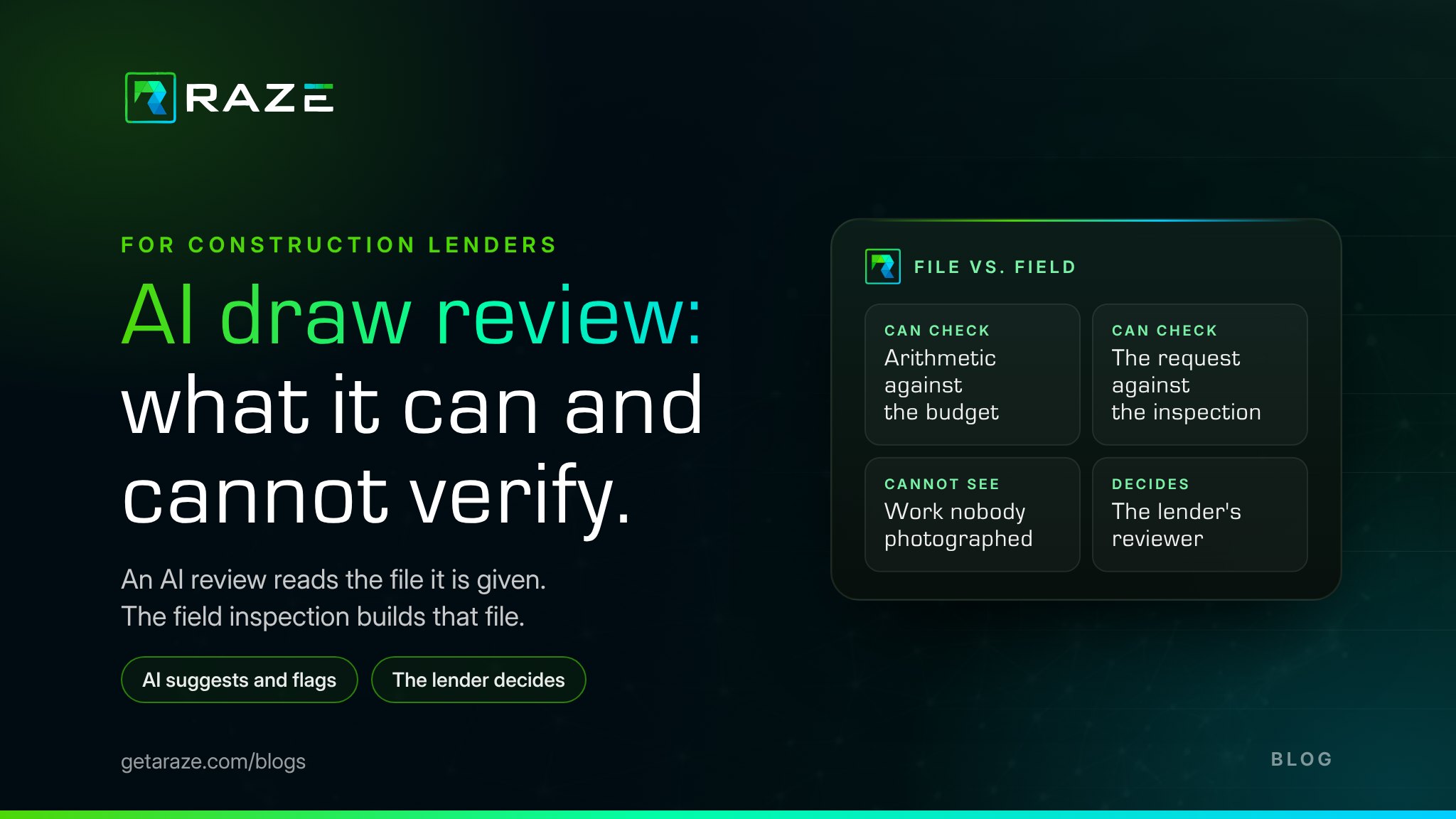
The honest answer is the file it was given. AI can compare documents, do the arithmetic and point out what is missing or inconsistent, quickly and the same way every time. It cannot stand on the site, and it cannot verify evidence nobody captured. AI draw review is only as good as the field capture feeding it.
This guide sorts what AI can verify in a draw from what it cannot, and covers what a reviewer should still check before funding.
What an AI review reads
A draw review works from documents. Depending on the lender's process, the file holds:
- The draw request, with the amount asked for each budget line
- The approved budget or schedule of values, and the draws already funded
- The draw inspection report: percent complete by line, photos and the inspector's answers
- Invoices, lien waivers and the title update
Everything an AI review concludes comes from those pages. When a page is missing, late or wrong, the review inherits the problem.
What AI can verify
Arithmetic against the budget
A model can check totals, retainage and each line's request against what is left to draw. A line asking for more than its remaining budget is a quick flag.
The request against the inspection
It can compare the percent complete requested on each line with what the inspector reported. "Framing requested at 100%, field photos support about 85%" is the kind of gap a reviewer needs to see before funding.
Completeness
It can confirm that every document the lender's policy requires is in the file: the inspection for this draw, photos for each line that moved and the waivers the policy calls for.
Consistency from draw to draw
It can spot lines that run ahead of the build sequence, amounts that move between lines, or a percentage that falls from one draw to the next. The red flags guide covers what each one can mean.
Capture data
When the capture tool recorded a location and a time with each photo, a model can check that they fall at the property on the visit date.
A flag is a question, not an answer.
A flag tells the reviewer where to look. The decision on the line, and on the draw, stays with the lender.
What AI cannot verify
Some of what decides a draw is not in any document. An AI review cannot confirm these on its own:
- Concealed work nobody photographed before it was covered
- Whether work meets the plans, the specifications or the code
- Stored materials off site, or on site but never photographed
- Whether every trade on the job was actually paid
- Whether the remaining budget will finish the house
- Conditions on the ground, from storm damage to an empty site
A waiver in the file shows a signed form, and the title update shows what has been recorded; neither is a payment ledger. Code compliance belongs to the builder and the building inspector. The rest are the questions a field inspection exists to answer. The FDIC's construction and land development examination procedures check that disbursements follow written inspection reports, lien searches and title updates. Those are examiner procedures for FDIC-supervised banks rather than a rule for every lender, so confirm your own requirements with counsel. A model reading the file can check that each piece is there and agrees with the others. It cannot supply a piece nobody captured.
When the model is wrong
Generative AI can be wrong with confidence. NIST's Generative AI Profile (AI 600‑1, July 2024), a voluntary framework, calls this confabulation: output stated with confidence that is false or unsupported, such as a line item or an amount that is not in the source document.
The defense is traceability. A flag should point to the line, the photo or the answer behind it, so the reviewer can open the source before deciding. A summary that cannot show its source is a prompt to check, not evidence. A missing flag never proves a line is supported, either.
Evidence decides what AI can check
The weak point of most AI draw reviews is the input, not the model. A request read against a photo set with no locations, a free-form report and percentages typed from memory gives a model little to compare.
Structured field capture changes that: required photos for each budget line, the same questions on every inspection, and location and time recorded when each photo is taken. Each flag can then point to its source, and the file keeps a chain of evidence a reviewer, an auditor or an examiner can follow. See what a draw inspection report should contain for the pieces.
What to ask about any AI draw review
- Can every flag be traced to the page, photo or line it came from?
- When evidence is missing, does the review say so, or fill the gap?
- Who approves the result before it changes a record or supports a funding decision?
- Can anything move forward without a person, and when?
What an AI-native label does not tell you
"AI-native" describes how a product is built. It does not say who approves what the AI produces before it reaches a draw file.
When AI output supports a funding decision, a reviewer should verify the underlying documents and calculations. AI tools can suggest and flag; the lender still decides what is funded.
Where RAZE fits
RAZE AI is AI-assisted: it suggests and flags, built on 51,000+ inspections submitted through the RAZE app (as of October 2026) and the field metadata captured with them. In the RAZE Mobile App, Photo Comment Assistance suggests clear, consistent comments for inspection photos, and the inspector decides what is saved. Draw Review Assistance checks draw requests against field evidence, including photos, line-item progress and questionnaire answers, and flags items that need a closer look before the draw moves forward. In the Ordering Engine, Ask AI drafts an order or a budget change from a plain-language request and creates nothing until the user confirms.
The evidence comes first. Lenders set the required questions and photos for each order, photos carry GPS coordinates and date and time stamps and link to the draw sheet line items they support, and each inspection keeps a history of its status changes and who made them. The lender's reviewer accepts or rejects each submitted inspection, unless the institution has turned on auto-approve, a workflow setting rather than an AI decision. RAZE does not approve draws or make lending decisions; funding stays with the lender.
Frequently asked questions
Keep reading
Evidence your AI review can check
Required photos, structured answers and a dated record on every order.
For Lenders
See a draw inspection on a project in your book, from order to delivered report.
Request a DemoOrdering Engine
Order, track and review every inspection in one place, your inspectors or ours.
See the Ordering EngineAI reads the file.The inspection builds it.
Give your AI review evidence worth checking.
Request a Demo