Rural and remote sites
Drive time, gated access and field roads shape every visit, and they belong in the plan for the order rather than in the report.
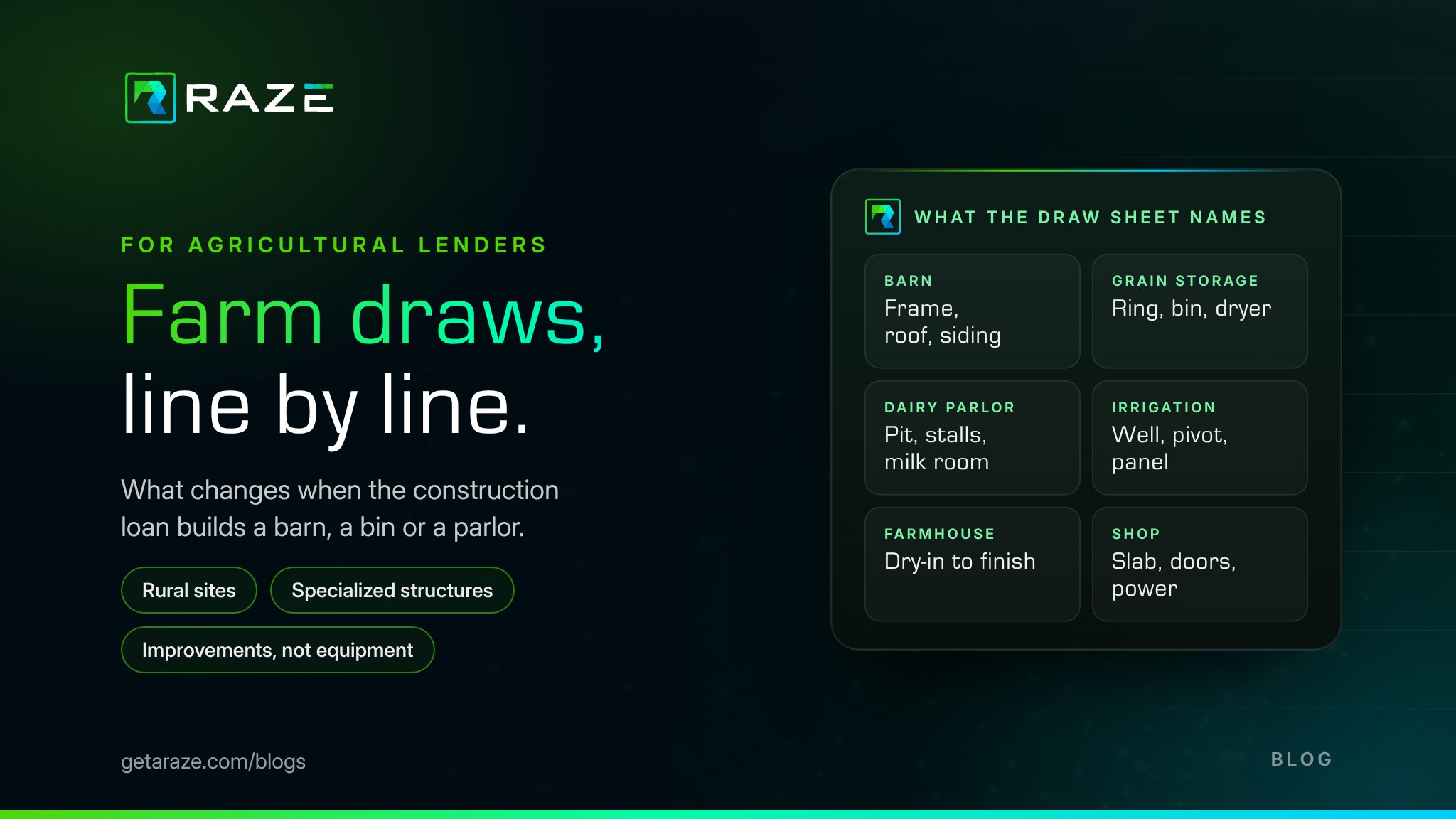
An agricultural construction loan pays for a building on a working farm: a machine shed, a grain bin and dryer, a dairy parlor, a center-pivot system or a farmhouse. The draw process is the one any construction lender runs, and the site is where it changes. Barns are not houses, the nearest inspector may be an hour away, and part of what the borrower bought will leave the property on wheels.
This guide covers what an ag lender, whether a Farm Credit association, a community bank with an ag book or a lender in a USDA loan program, should plan for when a construction loan builds on a farm. It describes draw inspections, not underwriting.
Drive time, gated access and field roads shape every visit, and they belong in the plan for the order rather than in the report.
A bin, a parlor or a pivot has stages a house never has, so the draw sheet has to name them before anyone can measure percent complete.
A farm build mixes real property with equipment, and the inspection documents the first while the collateral file tracks the second.
The Farm Credit Administration describes the Farm Credit System as banks that raise money in the securities markets and lend it to associations, which in turn lend to U.S. farmers, ranchers and other eligible borrowers. Community banks carry ag loans beside their other books. The USDA's Farm Service Agency makes direct farm loans; its Farm Ownership Loans page lists constructing, purchasing or improving farm dwellings and service buildings among their uses, and asks for a cost estimate of all planned development before loan approval.
Whoever holds the loan, the building goes up in draws, and RAZE's farm and agriculture page describes the inspection workflow built for them.
Treat the site as a planning input. Before the first order, record the drive time from the nearest town, how the inspector gets through the gate, whether livestock or an active field sits between the road and the building, and who meets the inspector. Seasonal conditions are assumptions rather than data: a field road that carries a truck in August may not in March, and harvest or calving can close a farm to visitors for weeks. Write those windows into the draw schedule.
Distance is not a reason to skip the visit. RAZE inspects at any U.S. address, and the nationwide draw inspection FAQ explains how rural properties are handled.
List the pad and site work, footings or posts, frame, roof, siding and doors, slab, and electrical and water, with the dimensions and building type the plans show.
List the foundation ring, bin erection, roof and ladders, aeration floor and fans, unload system, dryer and conveying, and electrical service.
List the shell, pit and platforms, stalls and gates, milk room and bulk tank plumbing, manure handling and ventilation.
List the well and pump, mainline and valves, pivot towers and spans, power drop and control panel.
Use the residential stages any construction lender knows; the draw inspection checklist covers each one.
A draw inspection documents what is built into the property: the structure, the systems installed in it and the site work around it. It does not document the tractor, the combine, the cattle, the seed or the feed, even when the same loan package paid for them; those are collateral the lender tracks through its own collateral inspections.
The line matters at the margin. A bulk tank plumbed into the milk room, a dryer bolted to its pad and wired to the service, and a pivot set on its point read as improvements, and the inspection records them installed and connected. The same dryer on a flatbed is a delivery, which the lender may treat as stored materials under its policy or leave unfunded until it is set.
An improvement is fixed to the land and working. Equipment that can leave on wheels stays out of the draw inspection and inside the collateral file.
On a farm the inspector often works alone at the far end of a section road, so the evidence has to stand on its own. Each photo should tie to the budget line it supports, carry the time and place it was taken, and show enough of the structure that a reviewer at a desk can tell a finished bin from a ring on a pad. The lender's report standard applies on a farm as it does in town.
The FDIC's agricultural lending examination procedures ask examiners to review how a bank monitors collateral values and margins, considering the frequency of on-site inspections, and to assess the controls that keep loan disbursements monitored and documented, considering the bank's timing and documentation of inspections.
For the draws themselves, the FDIC's construction and land development examination procedures check whether inspections happen before draw requests, whether reports are detailed enough to support disbursements, and whether funds go out only after management reviews written inspection reports, lien searches and title updates. None of these documents names a frequency or a tool; the guide to writing a draw inspection policy covers those choices, and on a farm the policy adds the draw sheets above and the equipment rule.
An ag lender orders draw inspections in the Ordering Engine, or through the RAZE API or the RAZE MCP from its own system, and sends each one to its own inspector through Direct Request or to a RAZE Marketplace inspector, at any U.S. address. Requirements can be set per project type, so a grain storage build, an irrigation project and a livestock facility each carry their own required photos, observations and completion criteria. The inspector completes them in the RAZE Mobile App, where photos carry GPS coordinates and date and time stamps and link to the draw sheet line items they support, and offline mode keeps capturing with no signal until the device reconnects. Every report comes back in the lender's format, whoever inspected.
RAZE integrates with the Construction Loan Administration workflow the lender already runs and replaces none of it; the lender decides what to fund. Residential draw inspection rates are on the RAZE Rate Card.
How to write a draw inspection policy
The seven sections most policies need.
What are stored materials in a construction draw?
Materials delivered but not yet installed.
Draw inspection report standard
What every report should hold.
Construction loan inspection frequency
What the FDIC researchers found.
Barns, bins, parlors and farmhouses, inspected to the same report.
See a draw inspection on a project in your book, from order to delivered report.
Request a DemoDraw inspections for ag construction loans, at any U.S. address.
See RAZE for Ag LendersOne report standard for every farm project.
Request a Demo