Construction Loan Portfolio Monitoring: Watch Lists
A draw file answers one question about one house. A construction book raises a different one: of all the loans open today, which need attention this week? Opening files one at a time is a slow way to find it.
This guide is for banks and credit unions. It covers the terms behind portfolio monitoring and a routine for acting on what it finds. Each lender sets its own thresholds and policy; nothing here replaces them.
The terms
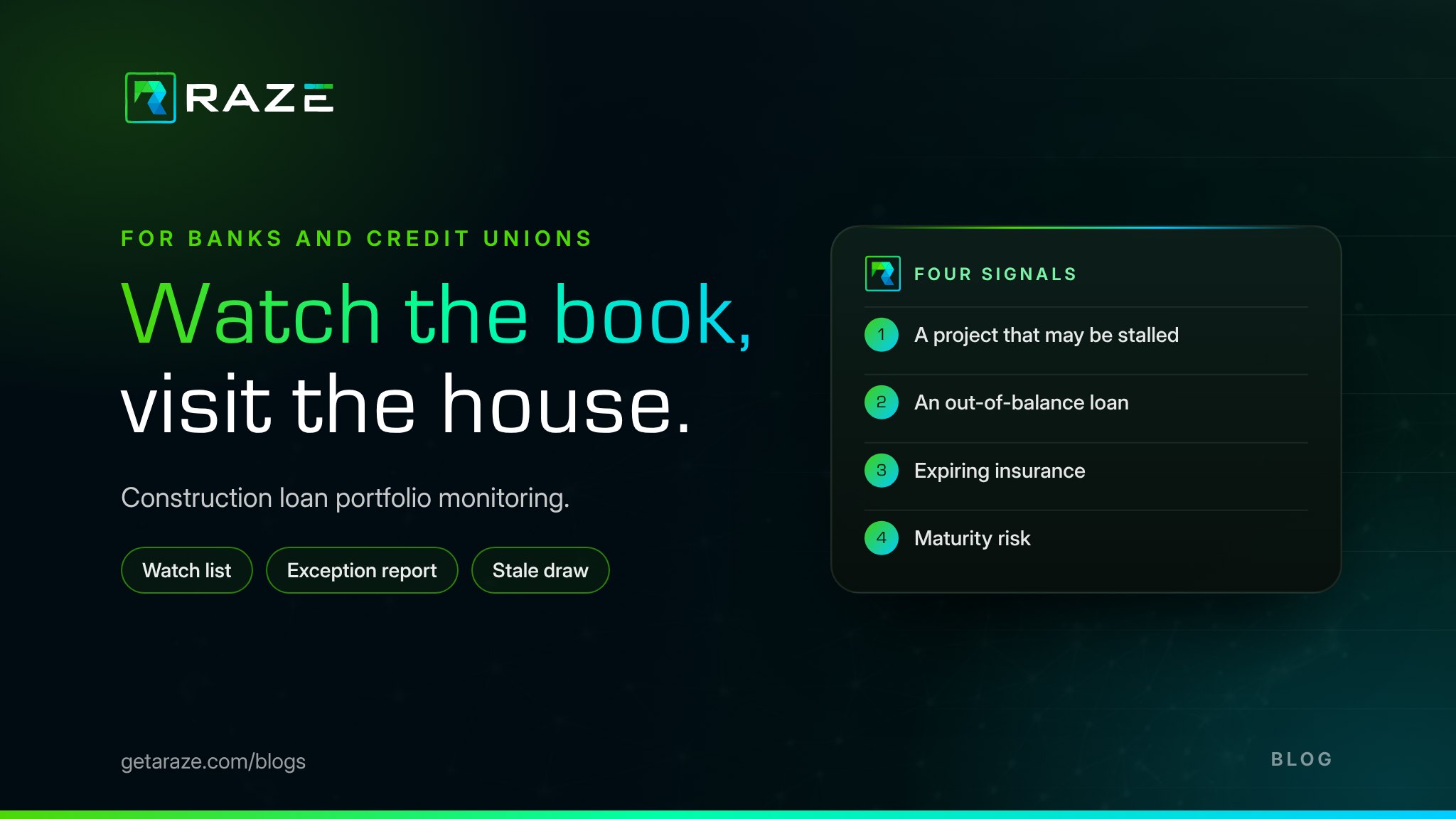
Portfolio monitoring is the ongoing surveillance of a construction loan book for stalled projects, out-of-balance loans, expiring insurance and maturity risk. Two terms sit beside it.
An exception report is a recurring report flagging loans that violate policy thresholds, such as out-of-balance budgets or missed completion dates. A watch list is the internal roster of loans showing early signs of weakness, reviewed regularly by credit administration.
Four signals to watch
| The signal | What it is | Where to look |
|---|---|---|
| A project that may be stalled | What it isA stale draw: no draw activity for an extended period | Where to lookThe dates of the last draw requests and inspections |
| An out-of-balance loan | What it isCost to complete above the undisbursed funds | Where to lookThe cost-to-complete review at each draw |
| Expiring insurance | What it isRequired coverage that is about to expire | Where to lookThe certificates of insurance in the loan file |
| Maturity risk | What it isThe loan reaching maturity without payoff or conversion | Where to lookThe completion date and the maturity date |
A routine for the whole book
Write the thresholds into policy
An exception report flags loans that violate policy thresholds, so the thresholds have to exist first. Say what counts as stale, out of balance or close to a date.
Run the exception report on a schedule
The report is recurring by definition. Pick the interval, name who reads it and say what happens to each loan it flags.
Keep the watch list current
Credit administration reviews the watch list regularly. A note on why each loan is on it helps the next review.
Check the site between draws
Lenders order an inspection between draws to record whether work is moving; the policy says when. The stalled loan guide covers what to document when it is not.
File what was decided
Keep the report, the inspection and the decision together, so the next review starts from the last one. The extensions guide covers the record for a loan near its date.
Concentration is a separate question.
This guide covers signals on individual loans. The ADC concentration guide and the examiner answer in Keep reading cover concentration.
Where RAZE fits
From the Ordering Engine, a lender orders an inspection before each advance, or between draws through the same workflow when a house looks stalled, and can schedule recurring inspections for a finished home waiting for a buyer. Photos carry GPS coordinates and date and time stamps and link to the draw sheet line items they support, so each report can be read against the one before it.
RAZE documents the work. Thresholds, watch lists and every lending decision stay with the lender.
Frequently asked questions
Keep reading
ADC concentration guidance
Construction monitoring and the concentration side.
How do examiners review construction loan monitoring?
What supervisors look for, with sources.
Work stopped? Record the site
What the record needs when a build stalls.
Construction loan extensions
What the inspection record shows near a date.
See the site between draws
Order an inspection before a draw or between draws, in one workflow.
For Lenders
See a draw inspection on a project in your book, from order to delivered report.
Get StartedThe exception report flags the loan.The site visit records what is there.
See the site between draws.
Get Started